What Is The Golden Hour In Amsterdam?
What the golden hour means in Amsterdam, when it falls through the year, and the best canals, bridges and rooftops to catch the city at its warmest light.
What Is The Golden Hour In Amsterdam?
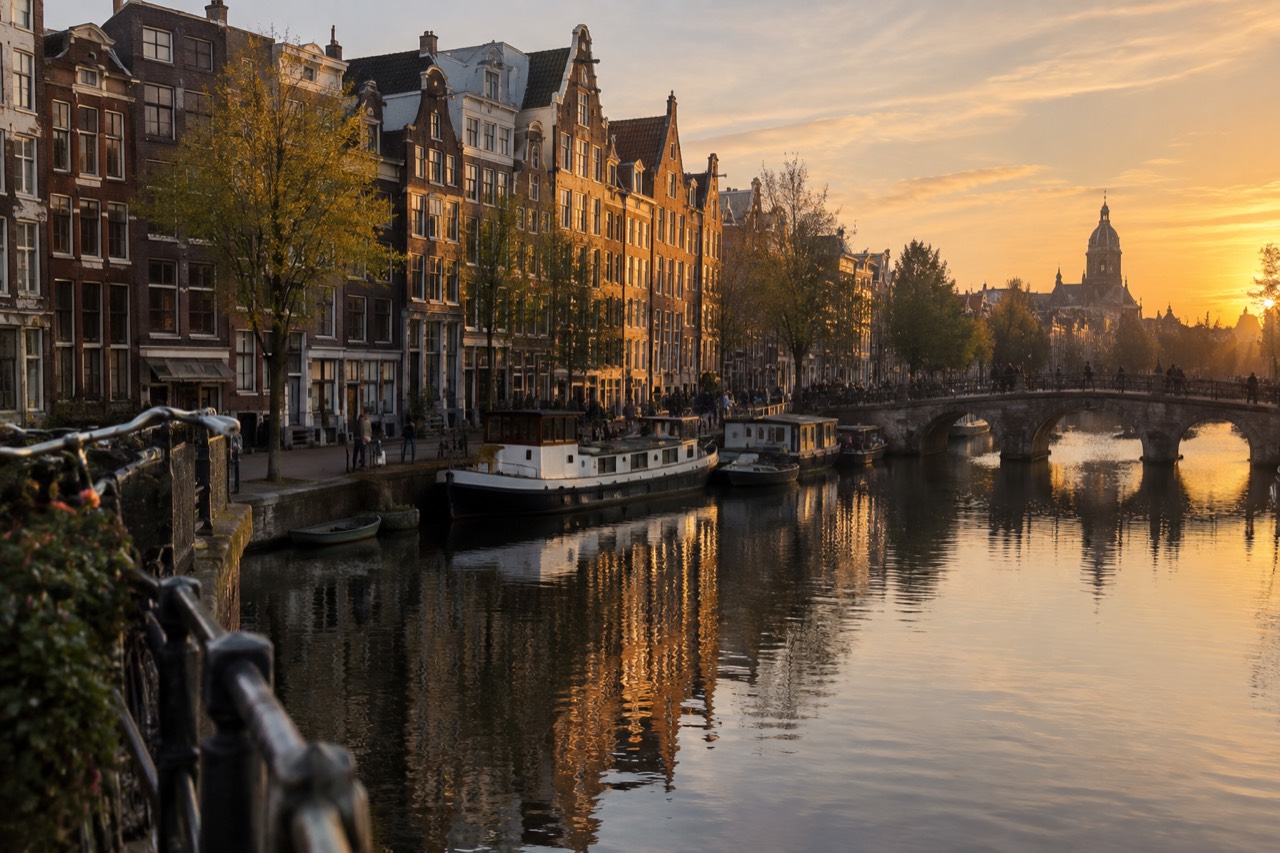
The golden hour in Amsterdam is the brief window of warm, low-angle light roughly an hour after sunrise and an hour before sunset, when the city's gabled facades, bridges, and calm canal water glow amber. Because the city sits far north, timing shifts dramatically across the year: winter brings a long, low golden hour in mid-afternoon, while summer pushes it close to bedtime, and photographers and rooftop drinkers plan around it.
The term itself comes from photography. Light travels through more atmosphere when the sun sits low, scattering the blue end of the spectrum and leaving the reds and ambers behind. That physics is the same everywhere. What makes Amsterdam unusual is the stage the light lands on: a dense ring of 17th-century canal houses, none taller than a few storeys, mirrored by flat water on both sides of every street. There is almost no modern glass to break the effect, so the whole neighbourhood bounces the colour back at you.
The city also faces a practical problem the physics does not mention. Amsterdam's weather is famously changeable, and the golden hour is not guaranteed on any given evening. Cloud cover can swallow the sun ten minutes before it matters. Locals who chase the light treat a good evening as a small gift rather than a scheduled event, which is a healthy way for a visitor to treat it too.
The reward for catching it is considerable. The canal ring is a UNESCO World Heritage site, and it earns that status most convincingly in low light, when the crowds thin, the tour groups disperse and the water goes glassy. If you plan one memorable hour in Amsterdam, plan it here.
When Does the Golden Hour Happen in Amsterdam?
Because Amsterdam sits far to the north, golden hour shifts dramatically with the seasons: in late June the evening golden light begins only after 21:00, while in late December it starts in the mid afternoon and the sun sets before 17:00. In between, spring and autumn offer evening golden light from roughly 19:00 to 20:00 in May and closer to 18:00 in October.
The summer case deserves a warning. Because the sky never fully darkens until late, the evening golden hour in June overlaps with the tail of dinner service, and the terraces are still full when the light peaks. If you want the classic empty-bridge photograph in summer, you either accept people in the frame or you chase the morning window instead, which begins around 05:00 and is the only genuinely quiet golden hour in high season.
Winter is the opposite and it is underrated. The sun barely climbs, so the light stays low and warm for much of the afternoon, and the low angle makes even a short walk along the Prinsengracht feel cinematic. The trade-off is rain, which arrives often, and early darkness that pushes everyone indoors by 18:00. A winter golden hour succeeds or fails on the cloud forecast, so check it the same day.
The shoulder seasons are the sweet spot for most travellers. April and September combine a reasonable sunset time with the softer, hazier air that makes the colour richer, and the tourist density is lower than in July and August. If your trip has any flexibility at all, aim the golden hour on the first clear evening of a shoulder-season visit rather than gambling a midsummer date.
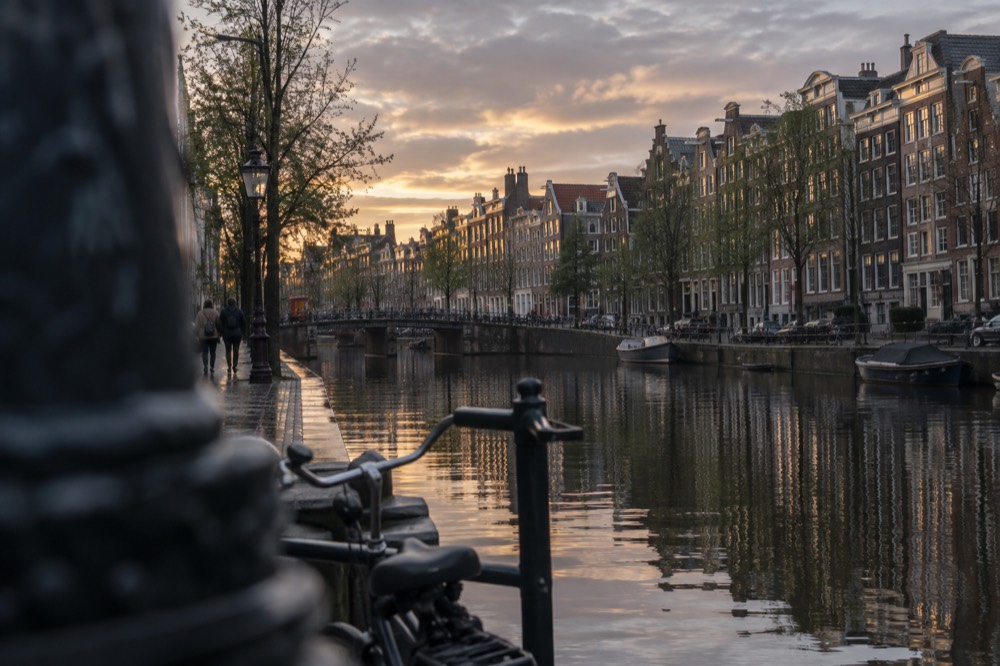
There is a second, quieter phenomenon worth knowing about: the blue hour, the twenty-odd minutes after the sun disappears when the sky turns deep blue and the city's warm window lights switch on. Amsterdam's canal houses lean forward slightly, a quirk of their construction, and in the blue hour every tilted facade catches the window glow from the houses opposite. Many of the best photographs of the city are actually blue hour photographs.
Where Are the Best Golden Hour Spots in Amsterdam?
The strongest golden hour spots in Amsterdam are the Magere Brug, the Skinny Bridge, the western stretch of the Prinsengracht, the A'DAM Lookout rooftop across the IJ, and the eastern edge of the Eastern Docklands, where the sun sets over the water rather than over rooftops. Bridges and west-facing canal banks work best, because the low sun needs an unobstructed path to light the facades rather than hide behind them.
The general rule is simple: face west in the evening. The sun sets in the west, so you want either water in front of you catching the reflection, or a row of facades angled into the light. The canal ring gives you both in abundance, but the orientation of each canal matters. Canals running east to west, like part of the Prinsengracht and the Brouwersgracht, catch the low sun along their full length and turn entirely gold, while north-south canals get a raking side light that suits tighter, moodier frames.
For a deeper list of angles, our Amsterdam photography spots guide covers the full circuit, and the best viewpoints and skyline spots page handles the city from above. The table below is the short list for the hour itself.
| Spot | What the light does | Best timing |
|---|---|---|
| Magere Brug (Skinny Bridge) | Old timber silhouette against the sunset over the Amstel | Evening golden hour, then blue hour |
| Prinsengracht, western stretch | Low sun runs the canal's full length, gables glow end to end | Evening golden hour |
| Brouwersgracht | Widest canal in the ring, houseboats and long reflections | Morning or evening |
| A'DAM Lookout, Amsterdam Noord | Panoramic sunset over the harbour and the old centre | Last hour before sunset |
| Eastern Docklands | Open water west of the quays, modern silhouettes | Evening golden hour |
The A'DAM Lookout deserves a specific note because it is the one spot on this list with a ticket. The observation deck is open daily until 22:00 with last admission at 21:00, so it comfortably covers sunset in every season. Adult entry is €16.50 booked online against €18.50 at the counter, and the "Over the Edge" swing, the one that hangs you over the edge of the tower, is a €7.50 online add-on for anyone at least 1.20 m tall, according to the official ticket page. The swing is a daytime thrill; the deck itself is a golden hour instrument.
Is a Golden Hour Canal Cruise Worth It?
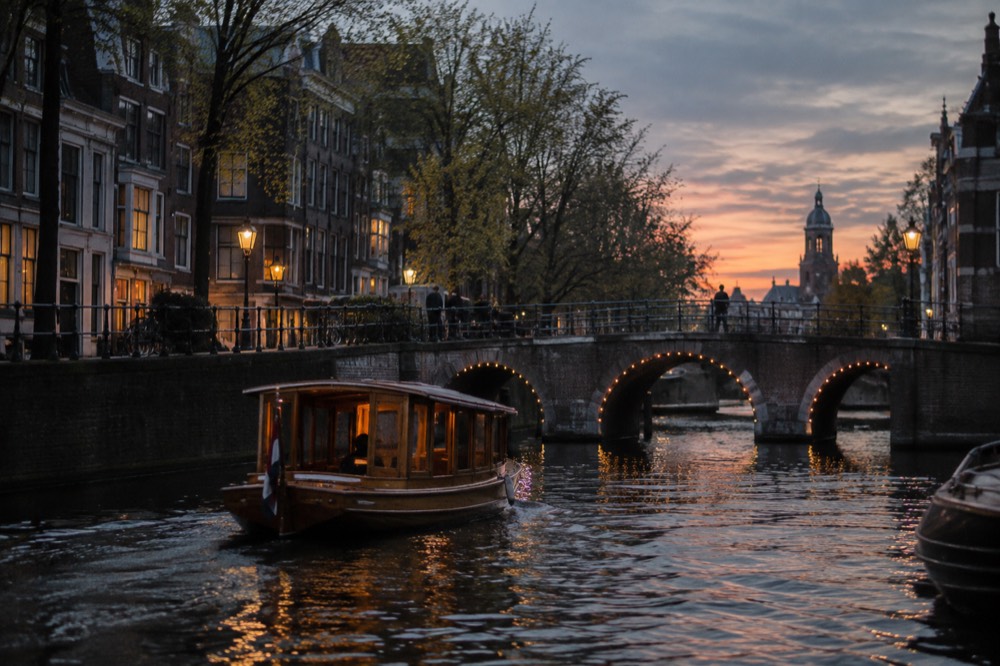
Yes, a golden hour canal cruise is worth it. In the last hour before sunset the low sun reaches under the bridge arches and lights the canal house basements, a level most walkers never see from street height. A one-hour cruise costs from about $16 to $29 per person depending on the boat, and small saloon boats, which sit low in the water, catch reflections larger glass-topped vessels miss.
The boat matters more than the route. Almost every cruise covers the same core of the canal ring, so the differences are in height, glass and group size. A classic wooden saloon boat sits close to the water, has open sides when the weather allows and holds fewer people, which means the light comes in rather than bouncing off a canopy. The larger sightseeing launches carry more passengers, run more often and cost less, and in the golden hour that trade-off is worth thinking about, because a crowded rail on the sunny side can block the view entirely. Everything else covered here is indexed on Things to Do in Amsterdam.
| Cruise | From | Rating | Length | Golden hour fit |
|---|---|---|---|---|
| Classic saloon boat cruise | $19.56 | 4.8 from 33,435 reviews | 1 hour | Low wooden boat, best reflections |
| Sunset canal cruise | $23 | 4.8 from 4,737 reviews | 1 hour | Timed for the sunset itself, drinks optional |
| Evening city lights cruise | $21 | 4.4 from 23,214 reviews | 1 hour 30 minutes | Spans golden hour into the blue hour |
Timing your booking is the part people get wrong. The sunset itself moves by minutes every day, so a cruise departing 90 minutes before sunset in summer may spend its whole hour in flat daylight, while the same departure in October is dead on target. Check the sunset time for your date, then pick a departure one hour before it. The sunset cruise product exists precisely to solve this, and you can Check availability for your dates; the operator's live listing shows the departure slots.
One honest caveat: the golden hour is not a light switch. On a hazy evening the light may be soft and grey rather than amber, and no boat can fix that. Book the cruise for the experience of the canals at dusk, treat the gold as a bonus, and you will not feel cheated by the weather.
Which Indoor Plans Work When the Golden Hour Fails?
When clouds kill the golden hour, the best indoor fallbacks are the ones that engage with light and colour anyway: the Van Gogh Museum, whose collection is built on the artist's obsession with evening light, the Heineken Experience in the old brewery, and the canal-side brown cafes, whose candlelit interiors were effectively designed for dark evenings. All three sit within a short walk or tram ride of the canal ring.
The Van Gogh Museum is the natural pick, and not only because it stays open into the evening. The museum is open daily from 9:00 to 18:00 and until 21:00 on Fridays, with a few published exceptions, per its official opening hours page, so a Friday visit lands you back outside just as the blue hour begins. Adult entry is €25 and every visitor needs a pre-booked timed ticket, which is exactly the kind of planning the golden hour rewards. The collection holds more than 200 paintings, and the evening scenes among them are a reminder that low light was Van Gogh's subject long before it was a photographer's term.
The Heineken Experience makes the list for a different reason: it is an evening-shaped attraction in a city where many museums close at 17:00. The ticketed experience runs about 90 minutes through the original 19th-century brewery, and it rates 4.6 across 39,581 reviews with tickets from $23. It is loud, commercial and unapologetically fun, which is precisely the right register after a grey afternoon. The rooftop option, when open, hands you a view over the De Pijp rooftops, though it is a city view rather than a sunset platform.
The brown cafe is the cheapest fallback and arguably the most Amsterdam one. These are the small, wood-panelled pubs that predate tourism by centuries, dim by design, with candles on the tables in winter. When the light fails, the correct local move is to accept it, find a window seat in a brown cafe on a corner where two canals meet, and watch the street lamps come on instead. The city glows a different colour then, and it costs the price of a beer.
How Do You Photograph the Golden Hour Well?
Good golden hour photography in Amsterdam comes down to three things: putting water in the frame so the light doubles, arriving before the light peaks so you can pick a composition calmly, and shooting the blue hour that follows as a second subject rather than going home. No expensive equipment is needed; a modern phone handles the exposure, and a steady hand against a bridge rail replaces a tripod in most situations.
Reflections are the whole game here. Every canal is a mirror, and the classic Amsterdam frame puts the lit facade in the top half and its reflection in the bottom half. To get both, stand on a bridge, not a bank, and shoot along the canal rather than across it. Wait for a gap in boat traffic, because a passing tour boat's wake smears the reflection for a minute or more. The stillness of the water in the last minutes before sunset is a real photographic resource, and patience is how you collect it.
Exposure is the technical trap. Cameras, including phones, want to brighten a darkening scene, which washes out the amber you came for. Tap to expose on the brightest facade in the frame, let the rest fall slightly dark, and the mood survives. If your phone has a RAW or night mode, resist using it until the sun is actually gone; during golden hour it overcorrects. The blue hour afterwards is where the night modes earn their keep, with the deep sky above and the warm windows below.
A few practical notes finish the job. The bridges and quays are public and free, so the only cost is time. Bikes are everywhere, and standing in a marked bike lane to shoot will earn you a bell and worse; pick your spot off the cycling surface. In the centre, remember that street drinking is prohibited, so enjoy the view with a coffee rather than a takeaway beer. And on the busiest summer evenings, the Magere Brug can hold a dozen photographers; arrive 30 minutes early or walk one bridge east, where the frames are nearly identical and the crowd is not.
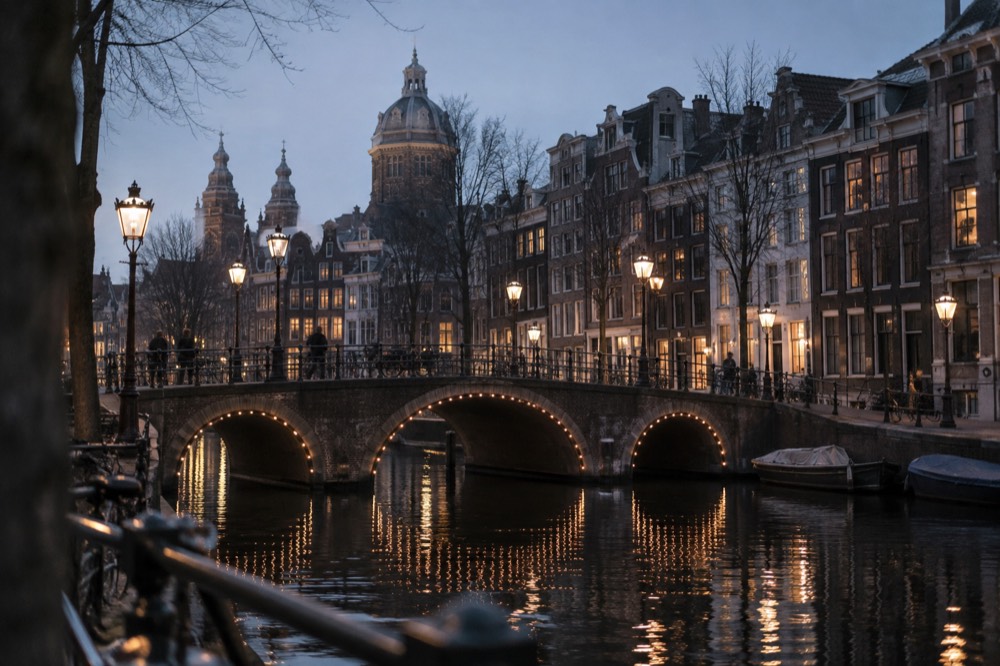
The last piece of advice is the simplest: build your evening around the light rather than trying to squeeze it in. Check the sunset time when you wake, pick one spot or one cruise, and give it a full unhurried hour. Amsterdam rewards that kind of attention more than most cities, because the light here has nowhere to hide. It lands on water, on brick and on glass, and for one hour every day, the whole city cooperates.
Common Questions About the Golden Hour in Amsterdam
What Is The Golden Hour In Amsterdam?
It is the window of warm, low-angle light roughly an hour after sunrise and an hour before sunset, when Amsterdam's canal facades and still water take on an amber glow. Because the city sits far north, the timing swings widely across the year, from the mid afternoon in December to after 21:00 in June.
What time is golden hour in Amsterdam in summer?
In late June the evening golden hour begins after 21:00, close to sunset, and the morning window starts around 05:00. Summer evenings stay light very late at Amsterdam's latitude, so plan dinner first and the light second.
Is the golden hour better in the morning or the evening in Amsterdam?
The light is similar, but the conditions are not. The morning window is far quieter, with empty bridges and glassy water, while the evening window is more social, with terraces and cruises still running. Photographers tend to prefer the morning; everyone else prefers the evening.
Where is the best place to watch the sunset in Amsterdam?
The Magere Brug over the Amstel is the classic spot, the western stretch of the Prinsengracht catches the sun along its full length, and the A'DAM Lookout gives a rooftop panorama from across the IJ. All face the sunset over water or along a canal rather than into rooftops.
Do I need a cruise to enjoy the golden hour in Amsterdam?
No. Every bridge and quay in the canal ring is free and public, and the light is the same from the pavement. A cruise adds the low, water-level perspective and someone else handling the timing, which is why the sunset cruises are popular, but the golden hour itself costs nothing.
What is the blue hour and does Amsterdam have one?
The blue hour is the roughly 20-minute window after sunset when the sky turns deep blue and artificial lights take over. Amsterdam has a particularly good one, because the leaning canal houses catch the warm window light from the houses opposite, and many of the best photographs of the city are taken in it.