Is It Cheaper To Fly Or Train From London To Amsterdam?
A straight cost comparison of flying versus taking the train from London to Amsterdam, with the hidden charges that decide the real answer.

Is It Cheaper To Fly Or Train From London To Amsterdam?
Neither option wins outright, because the answer flips with the booking date and the baggage. Budget flights from London to Amsterdam sometimes show fares well below the train, but once you add the airport transfer at both ends, baggage charges and the extra hours of travel time, the high-speed train frequently lands close to or below the flight's true total. Booked early, the train is usually the better value; booked late, the plane often wins on price alone.

The fare you see first is almost never the fare you pay. A low-cost flight from London to Amsterdam can appear on a comparison site at a price that seems unbeatable, and then quietly grow with a cabin-bag fee, a seat-selection charge and the cost of two airport journeys. The train ticket, by contrast, tends to be the price it says it is: your luggage travels with you at no extra charge, and the stations at both ends sit in the middle of the cities you are actually visiting.
The honest comparison has to count everything. That means the headline fare, the transfer to and from each airport or station, baggage, and the value of the three to four hours the door-to-door journey takes. This page works through each of those in turn, using verified figures for the Amsterdam end of the trip and plain reasoning about the London end, where fares move daily and no single number stays true for long.
| Cost factor | Flying from London | Train from London |
|---|---|---|
| Headline fare | Lowest on the screen, moves daily | Higher at short notice, stable when booked early |
| Baggage | Cabin bags often charged extra | Included, no weight limit drama |
| Arrival point | Schiphol, about 17 minutes by train from the centre | Amsterdam Centraal, in the centre already |
| Transfer cost | Added at both ends | None at the Amsterdam end |
| Door-to-door time | Longer than the flight time alone suggests | Competitive, city centre to city centre |
The pattern that emerges is simple. The flight wins the fare comparison on the day you happen to look, and the train wins the total-cost comparison once the extras are counted. Travellers who book weeks ahead and pack light can make either option cheap. Travellers who book late, or who carry a checked bag, usually find the train has already closed the gap before the holiday begins.
How Much Does the Train From London to Amsterdam Actually Cost?
Train fares from London to Amsterdam are dynamic, rising as departure approaches and as flexible-refund options are added, so there is no honest fixed price to print here. What can be said firmly is that the cheapest fares appear when booking opens and sell out first, that a return journey booked early typically costs less than two late singles, and that the price you see is the price you pay, with baggage and city-centre arrival included.
The train between London and Amsterdam runs through the Channel Tunnel and arrives directly at Amsterdam Centraal, which matters for the budget in a way the fare alone does not capture. Centraal sits at the northern edge of the historic centre. Step off the platform and you are a short walk from the canal ring, with no transfer to buy. Compare that with a flight, which lands at Schiphol and then requires a second ticket, a bus or a taxi before the city begins.
Booking behaviour is the single biggest lever on price. Fares are released months ahead and the cheapest seats go first, particularly around weekends, school holidays and major events in either city. A traveller who commits early often pays a fraction of what a same-week buyer pays, and that early-bird train fare is the number that beats most late-booked flights. A traveller who leaves it to the last few days will usually find the plane cheaper, because airlines keep selling seats at whatever the market will pay while the cheapest train fares have long gone.
There is a second saving the fare screens do not show: the absence of baggage charges. On the train, a suitcase is a suitcase. On a low-cost flight, a hold bag or even a larger cabin bag can add a meaningful percentage to the total, and the charge is highest when paid at the airport rather than online. Anyone travelling with more than a small backpack should add that cost to the flight side of the ledger before declaring a winner.
For the wider picture of rail routes into the city, including the London service alongside options from Paris and Brussels, the trains to Amsterdam from London guide breaks down the routes, operators and arrival logistics in more depth than this comparison needs.
What Are the Hidden Costs of Flying to Amsterdam?
Flying adds three costs the fare does not show: the transfer to the London airport, the transfer from Schiphol into Amsterdam, and baggage fees that climb sharply if paid at the gate. The Schiphol leg is well defined, with NS trains taking just over 17 minutes and e-tickets from €5.50, while the airport bus starts from €6.50. Add those to the flight and the "cheap" fare often stops being cheap.

Schiphol is one of Europe's better-connected airports, which works in the flyer's favour, but the connection still costs money and minutes. The NS route page quotes e-tickets from €5.50 for the journey of just over 17 minutes into Centraal. The Amsterdam Airport Express bus 397, which serves the city centre on a slower but useful route, starts from €6.50 for a single, and the same ticket is valid on the Niteliner N97 for late arrivals. There is no fixed taxi fare: Schiphol's own guidance says you pay whatever the meter shows, so anyone quoting you a guaranteed taxi price in advance is guessing.
Then there is the accommodation end of the trip, which surprises many first-time visitors. Amsterdam levies a tourist tax of 12.5% of the overnight price at hotels and holiday rentals, as set out on the gemeente's tourist tax page. That applies however you arrive, so it does not decide the fly-versus-train question, but it belongs in any honest budget for the city, and it is worth knowing before the hotel bill arrives.
| Transfer from Schiphol | Typical cost | Time to the centre | Notes |
|---|---|---|---|
| NS train to Amsterdam Centraal | From €5.50 | Just over 17 minutes | E-ticket, frequent departures |
| Amsterdam Airport Express bus 397 | From €6.50 single | Slower, city-centre stops | Same ticket valid on N97 night bus |
| Taxi or ride-hail | Metered, no fixed fare | Depends on traffic | Schiphol publishes no guaranteed price |
| Train arrival at Centraal | Nothing extra | Already there | The train traveller walks straight out into the centre |
The London end mirrors this. Whichever airport the flight departs from, the Stansted Express, the Gatwick train or a coach ticket adds both money and an hour or more to the journey. A fair comparison adds the same transfer allowance to both sides, and when you do, the flight's time advantage shrinks to almost nothing while its cost advantage often disappears entirely.
One more quiet cost of flying is rigidity. Low fares are usually non-refundable, and a delayed flight can cascade into a missed evening in Amsterdam. The train has its own disruption risks, but a missed departure is typically rebooked on the next service rather than rewriting the whole itinerary.
Which Is Faster From London: Plane or Train?
The flight itself is shorter, roughly an hour and twenty minutes in the air, but the door-to-door journey is not. Airport processing, transfers at both ends and the Schiphol-to-centre leg add several hours to the flying day. The train runs city centre to city centre in a single seated journey, so for total travel time the two options are close, and the train is often ahead once security queues and transfers are counted.
Speed is where the flight's marketing is strongest and its reality is weakest. The scheduled flight time between London and Amsterdam is short, but the traveller's day does not start at the departure gate. It starts at home, with a journey to the airport that for most London residents means an hour on a train or coach, followed by a check-in and security window that airlines ask you to arrive two hours early for. On the Amsterdam side, add the walk to the station, the wait for the next train and the 17-minute ride into Centraal.
The train journey, by contrast, is one block of seated time. You arrive at a central London station perhaps thirty minutes before departure, pass through a quick border and security check, and step off in the middle of Amsterdam. There is no transfer to plan, no baggage belt to wait at and no second ticket to buy. For anyone whose accommodation is in the centre or the canal ring, the train delivers you closer to your bed than any flight can.
The practical difference shows up in what you can do with your arrival day. A morning train departure can have you in Amsterdam before early afternoon with the whole day ahead. A morning flight, with its earlier wake-up and longer process, often delivers you at a similar hour but more tired, and having spent the difference on transfers. Anyone planning a short break, where every hour counts, should weigh that as a real cost even though no receipt shows it.
Is the Train From London More Comfortable and Reliable?
Yes, in most measurable ways. The train offers more legroom, no baggage restrictions beyond common sense, the ability to walk around, and a seat with a table for most of the journey. Reliability is broadly comparable, with both modes occasionally disrupted, but a missed train connection is usually rebooked on a later service, whereas a cancelled low-cost flight can cost a day and a second fare.
Comfort is not a luxury question on this route, because the journey is long enough to matter. On the train you sit in a spacious airline-style seat, often facing a table, with space for a full-size suitcase on the racks at the end of the carriage. There is a café car, phone signal for most of the route, and the freedom to stand up whenever you like. On a low-cost flight you sit in a fixed seat with a tight cabin-bag allowance, and anything larger costs money.
Reliability deserves a plain answer rather than a promise. Both the train and the flights are subject to disruption: the train can be hit by signalling problems or tunnel delays, and flights by weather, strikes and slot congestion. The difference is what happens afterwards. Train operators generally rebook affected passengers onto later departures the same day. Airlines do rebook too, but on busy London-Amsterdam days the later flights are often full, and a low-cost ticket may leave you buying a new fare at walk-up prices. For a traveller with a hotel booked and a short trip planned, that asymmetry is worth real money in expectation.
There is also the environmental argument, which many travellers now weigh alongside price. The rail journey produces a fraction of the emissions per passenger of the equivalent short-haul flight, and while this page is a cost comparison, it would be dishonest to pretend the factor does not influence plenty of people's choice on this exact route.
What Can You Do in Amsterdam on a Tight Budget?
A lot, because Amsterdam's best experiences include a large free layer. The canal ring itself costs nothing to walk, the city's pay-what-you-want walking tours are free to book, and a GVB day ticket at €10.00 covers unlimited trams, buses, metro and ferries for 24 hours. Arriving by train puts you within walking distance of most of it, so a budget trip loses nothing by skipping the taxi ranks.
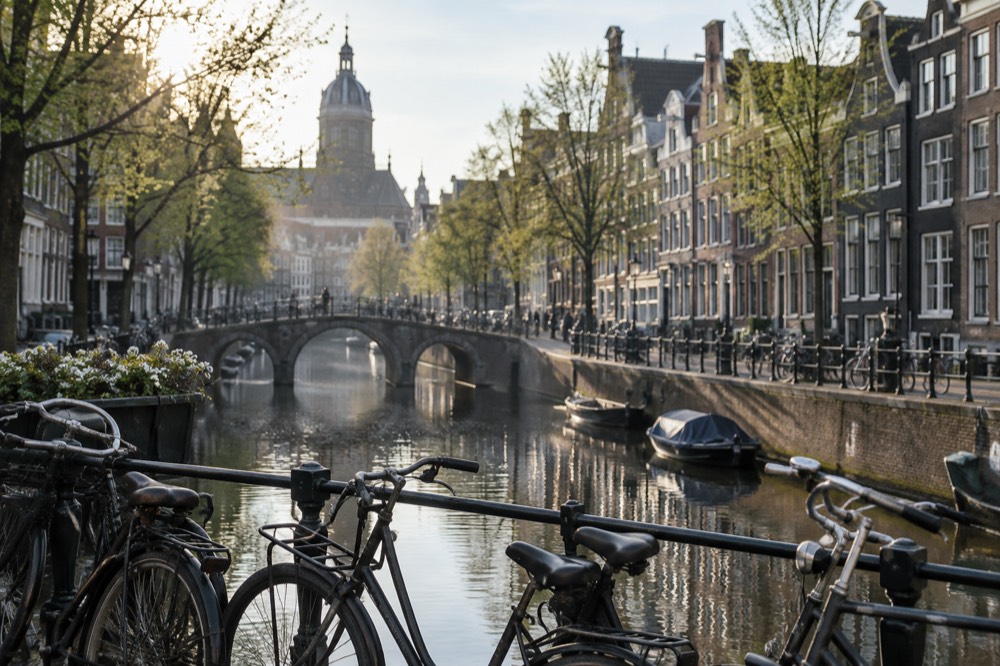
Whichever way you arrive, the money you saved on the journey can stretch further in Amsterdam than in most capitals. The canal ring, a UNESCO-listed streetscape, is free to wander. The Begijnhof, the Nine Streets and the Jordaan's back streets cost nothing but shoe leather. The Vondelpark is free, the ferry across the IJ to Amsterdam Noord is part of the public transport network, and the bloemenmarkt is a market: browsing is free.
The free walking tours deserve a specific mention because they are the single best-value structured activity in the city. The Absolutely Amsterdam walk, the most reviewed free city walk on GuruWalk, runs 2 hours 30 minutes and is free to book: you tip the guide what the walk turned out to be worth. The Essential Amsterdam walking tour, also on GuruWalk, is an adults-only 1 hour 30 minute version, and the Jewish Quarter and WWII walk covers the Anne Frank story in the streets for the same pay-what-you-want model. These are real guided tours with real local guides, not sales pitches.
If you would rather spend a little on a classic, a one-hour canal cruise is the city's signature paid experience and it does not have to be expensive. The standard cruise with an audio guide, departing from three docks including Centraal Station, is one of the cheapest ways onto the water, and arriving by train puts you a few minutes' walk from the departure points.
For the full picture of what costs nothing in this city, the free things to do in Amsterdam guide lists the no-cost layer in detail, from courtyards to street markets. And if you are still weighing the arrival logistics rather than the fare alone, the getting from Schiphol to central Amsterdam guide covers every transfer option with current prices.
When Does Flying Beat the Train From London to Amsterdam?
Flying wins in three specific situations: when you book very late and the cheap train fares have sold out, when a promotional airfare appears at a price no rail ticket can match, and when you live closer to a London airport than to the St Pancras area and would pay for a long cross-city transfer to reach the train. Outside those cases, the train usually matches or beats the true total.
Late booking is the big one. Train fares on this route climb steeply in the final week before departure, while airlines keep selling seats at whatever price the last-minute market supports, which on quiet midweek days can be very low. A traveller deciding on Tuesday for a Friday trip will often find the flight genuinely cheaper, and this page would rather say so than pretend the train always wins.
Promotional fares are the second case. Airlines on the London-Amsterdam corridor discount aggressively in low season, and a headline fare that undercuts even an advance-purchase train ticket appears often enough to be worth checking before you commit. The discipline is to add the baggage fee, both airport transfers and the value of the extra hours before declaring victory, because a promotional fare plus a hold bag plus two transfers is not always cheaper than a train seat.
Geography is the third. The train departs from central London. If your home or hotel is in, say, the far south or east of the city with an airport on your doorstep, the transfer to the international station may cost as much as the flight's own extras. In that situation the honest comparison can favour the plane, and it is the traveller's starting point, not the mode, that decides it.
For most people, on most dates, the summary stands: book the train early and it is usually cheaper door to door; book late and fly, but pack light. Either way, Things to Do in Amsterdam starts the moment you step off, and the city rewards whichever budget you arrive with.
Common Questions About Flying or Taking the Train From London to Amsterdam
Is It Cheaper To Fly Or Train From London To Amsterdam?
It depends on when you book. Early-booked train fares usually beat the true door-to-door cost of flying, because the train includes baggage and arrives in the city centre. Late-booked flights often show lower headline fares, but airport transfers at both ends and baggage fees can erase the saving. Compare totals, not fare screens.
How long does the train from London to Amsterdam take?
The train runs city centre to city centre in a single seated journey, with the London and Amsterdam stations both in the middle of their cities. Door to door it is competitive with flying, because the flight's airport processing and transfer times add several hours to the shorter time in the air.
How do I get from Schiphol Airport to central Amsterdam?
The NS train takes just over 17 minutes from Schiphol to Amsterdam Centraal, with e-tickets from €5.50. The Amsterdam Airport Express bus 397 starts from €6.50 and the same ticket is valid on the N97 night bus. Taxis are metered with no fixed fare published.
Does the train ticket include baggage?
Yes. Rail passengers bring suitcases at no extra charge, with racks at the end of each carriage. Low-cost flights typically charge for hold bags and sometimes for larger cabin bags, and those fees rise sharply when paid at the airport instead of online.
Is Amsterdam expensive once I arrive?
It can be, but it has a large free layer: the canal ring, major parks, markets and the pay-what-you-want walking tours all cost little or nothing. A GVB 24-hour transport ticket is €10.00 for adults, and the tourist tax of 12.5% of the overnight price applies at hotels and holiday rentals.
When is flying definitely the better choice?
When you book very late and the cheap train fares have sold out, when a promotional airfare undercuts everything else, or when you live much closer to a London airport than to the central London station the train departs from. In those cases the flight is the honest winner.