What Do The 3 X's Mean In Amsterdam?
The three X's on Amsterdam's coat of arms and flag explained: where the crosses came from, what people claim they mean, and where to spot them around the city.
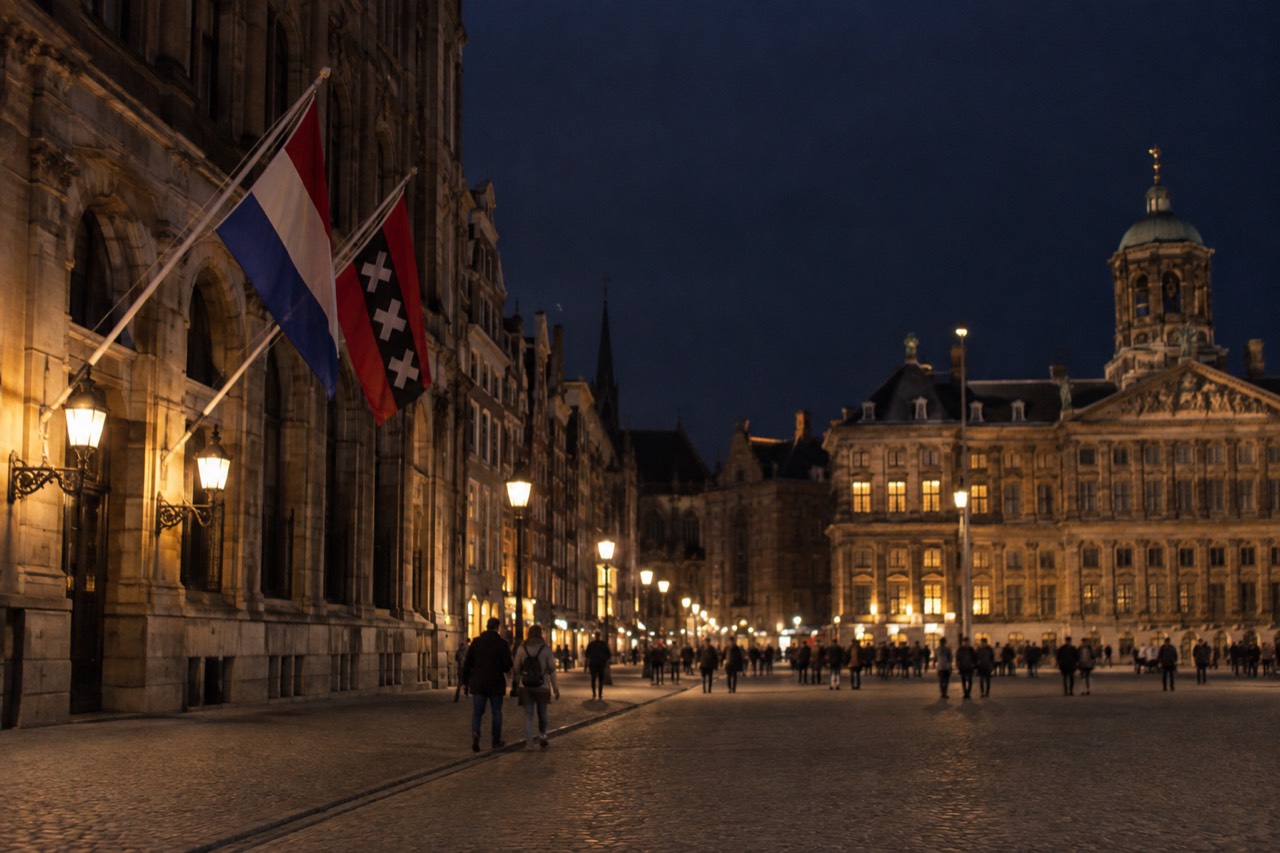
The three X's are the single most recognisable symbol in Amsterdam. They sit on the city's coat of arms, on its flag, on the shields bolted to canal bridges and on the front of every municipal rubbish bin in the centre. Visitors photograph them constantly, and a fair number assume they are kisses, or a warning, or something to do with the city's permissive reputation. None of those guesses is right, and the real story is older and stranger than most of the myths.
What Do The 3 X's Mean In Amsterdam?
The three X's are the crosses of Saint Andrew, taken from the coat of arms of Amsterdam, the city's official emblem since the Middle Ages. They are not kisses and not a rating. The most widely repeated interpretation is that they stand for the three great adversities of the city's early history: fire, flood and plague, though historians treat that reading as tradition rather than documented fact.
That is the short answer, and it is worth pausing on how unusual it is. Most cities put a building or an animal on their arms. Amsterdam put three bare crosses on a red shield, with a crown above it and two golden lions holding it up. The crosses are shaped the way they are because they are saltires, the X-shaped cross associated with Saint Andrew, the apostle who by tradition was crucified on a diagonal cross because he considered himself unworthy to die on the same shape as Christ.
The crown above the shield is its own piece of history. It is the imperial crown of Austria, granted to the city by Maximilian of Austria during a period when Amsterdam was banking money for the Habsburgs. Very few cities were ever allowed to place an imperial crown on their arms, and Amsterdam has kept it through every regime change since. The lions came later, and the whole arrangement, shield, crown, lions, has been stable for centuries.
So the X's are not decoration and they are not modern branding. They are the surviving core of a medieval heraldic emblem, and everything else on the souvenir hoodies, the beer glasses and the bridge shields is a descendant of that shield. If you want to see the city at its most symbolic after reading this, the classic trio of ways in is below.

Where Did the Three Crosses Come From?
The crosses entered Amsterdam's arms in the late Middle Ages, borrowed from the arms of the lords of the Persijn family, who held land around Amsterdam and whose own shield carried three saltire crosses. The city adopted them as its own mark, and by the time the imperial crown was granted, the three crosses were already firmly the city's symbol.
The Persijn connection is the explanation historians actually support, and it is far less romantic than the fire, flood and plague story. Jan Persijn and his descendants administered the area around Amsterdam in the medieval period, and their heraldry, three X-shaped crosses on a red field, appears to have been taken over by the growing town as it asserted itself as an independent commercial power. Medieval towns borrowed the arms of their local lords all the time, and Amsterdam's version simply outlived the family that inspired it.
The dating matters because it kills the most popular myth outright. The crosses were on the city's seal long before the plague hit Amsterdam hard, and before the great fires that destroyed whole neighbourhoods of wooden houses. A symbol cannot commemorate disasters that happened after it was already in use. What the tradition probably reflects is later Amsterdamers working backwards, looking at three crosses and deciding they must stand for the three worst things that had ever happened to the place.
That working backwards is itself centuries old now, which gives it a strange legitimacy. The fire, flood and plague reading appears in older city chronicles and has been repeated by guides for generations. It is not what the crosses meant when they were adopted, but it is what many Amsterdamers have believed they meant for a very long time, and a symbol that everyone agrees means something arguably does mean that thing, whatever its paperwork says.
There is a second, smaller myth worth clearing up while we are here: the X's have nothing to do with the letters in the word Amsterdam, and nothing to do with the abbreviation "XXX" used to mark adult content. The resemblance is a coincidence of shapes. A saltire cross and a capital X look identical, which is exactly why the confusion spreads, but heraldry came first and by several hundred years.
What Do the Three X's Actually Stand For?
The honest answer is that nobody documented the original meaning, so the interpretations are layered: the heraldic origin with the Persijn arms is best supported, the fire, flood and plague reading is the most beloved tradition, and a third reading links the saltires to Saint Andrew as a protective mark against those same dangers. All three circulate freely in the city today.
Because the sources are thin, it helps to lay the competing readings side by side and see what each one claims. Here is the full picture.
| Interpretation | What it claims | How solid is it |
|---|---|---|
| Persijn family arms | The crosses were borrowed from the heraldry of the medieval lords who held land around Amsterdam | The version historians support; the arms predate the disasters they supposedly mark |
| Fire, flood and plague | Three crosses for the three great adversities of the early city | A long-standing local tradition, but the crosses existed before the events, so it cannot be the original meaning |
| Saint Andrew's crosses | The saltires invoke Saint Andrew as a guardian against fire and water | Plausible as medieval religious symbolism; the X shape is genuinely the saint's cross |
| Kisses or a rating | The X's are kisses, or mark the city's permissive side | A modern tourist reading with no historical basis at all |
The Saint Andrew angle deserves a little more room, because it ties the symbol to the physical city. Amsterdam spent its first centuries fighting water above all else, and a protective saint's cross over a town below sea level is exactly the kind of insurance a medieval merchant would want on his town seal. Whether that was the conscious reasoning at the time is unknowable, but the shape of the cross is genuinely the saint's, and the protective reading at least respects the chronology, unlike the plague version.
The kissing reading, by contrast, is pure souvenir-shop folklore, and it says something about how the city markets itself that so many visitors reach for it first. Amsterdam has been happy to let the ambiguity stand. A symbol that reads as a warning, a blessing and a wink all at once is a powerful thing to put on a glass, and the city's own tourism materials have never gone out of their way to correct anyone.
If the layered meanings appeal to you, the city's museums are where the symbols turn into objects you can stand in front of, and the Van Gogh Museum is the one most visitors regret skipping. You can also read our guide to the Rijksmuseum's highlights for the older end of the city's visual history, from the same centuries that produced the coat of arms.
Where You'll See the XXX Around the City
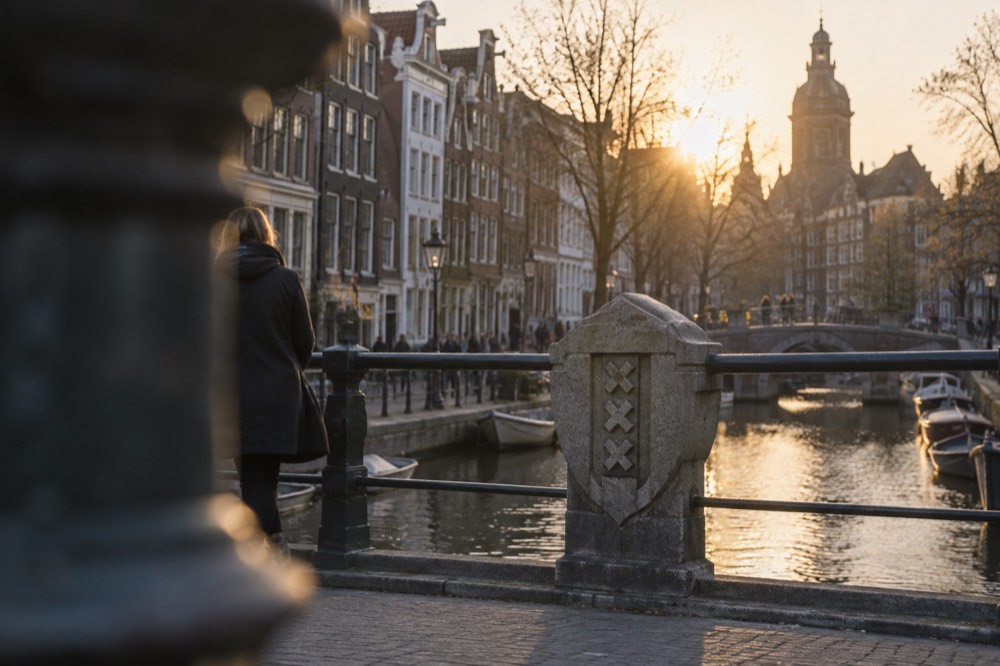
You will see the three crosses on the city flag flying on public buildings, on the carved stone and iron shields of canal bridges, on the ornamental spouts of the 17th-century watering points along the streets, and on municipal furniture from bins to ferry terminals. Once you know the shape, you start spotting it everywhere in the centre.
The best hunting grounds are the canal ring, where the historic bridge parapets carry the full arms with the crown and the two lions. The stone versions on the larger bridges are the most impressive, and the smaller iron shields repeat the pattern on crossings you might otherwise walk past. Look down as well as across: the city's older street furniture carries the emblem too, and some of it has been repainted so many times that the crosses have taken on a soft, hand-painted quality the modern stickers never manage. The wider set of guides lives on Things to Do in Amsterdam.
The flag itself is worth a deliberate look, because its design is unusual among city flags. A black stripe with three white X's runs horizontally across the red, white and blue of the Dutch national colours, which means the crosses sit directly on the national flag's pattern. It is a neat visual statement of what Amsterdam is: a city inside a country, distinct but embedded. When the flag flies next to plain tricolours on a row of flagpoles, the difference reads instantly.
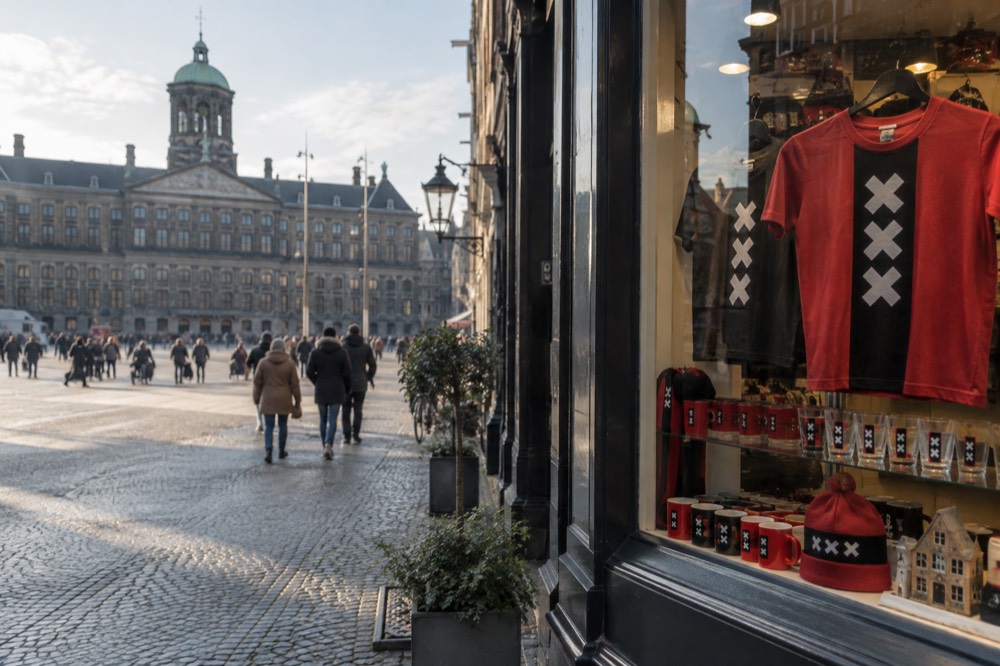
Then there is the modern commercial layer. The XXX appears on glasses, shirts, stickers, neon signs and at least one well-known beer brand's city-themed packaging, and the city government has at various points contested commercial uses of its actual coat of arms while leaving the general three-cross motif free for everyone. That tension between official emblem and open brand is itself part of the symbol's modern life, and it explains why the X's feel simultaneously civic and rebellious depending on where you see them.
A walking afternoon built around spotting the arms is a genuinely good free activity, and it pairs naturally with the canal ring and Grachtengordel guide, since the bridges with the best stone shields sit on the main canal crossings. If you would rather have someone else point them out, the Heineken Experience below is in a building from the same era of the city's branding, and it is one of the most visited paid attractions in the centre.
Do the X's Mean Kisses on Amsterdam Souvenirs?
No, the X's on souvenirs are the city's crosses, not kisses, but the confusion is understandable and even useful for the shops. An X reads as a kiss in English-speaking countries, as a signature for someone who cannot write in older documents, and as a warning label in modern signage, so the same shape sells innocence, history and naughtiness to three different customers at once.
The souvenir industry has quietly leaned into all three. A glass printed with XXX can be sold as a piece of heraldry to one buyer and as a cheeky joke to the next, and nobody in the shop needs to explain the coat of arms for either sale to close. This is not a complaint, it is just how symbols work once they escape their original context. The swan on a city gate and the swan on a casino sign are the same bird doing different jobs.
What is worth knowing as a visitor is which version of the symbol you are looking at. The official arms, red shield, three black saltires, imperial crown, two golden lions, appear only in civic settings and on licensed uses. The stripped-down XXX on merchandise is a free-floating motif that anyone can print, which is why it shows up in places the city would never put it. Once you can tell the full arms from the bare letters, you can read the streets a little more sharply.
It also changes how you read the jokes. When a bar sign plays on the X's, it is trading on a centuries-old emblem, and the wink only lands because the crosses already carry the weight of the real city behind them. The naughtiness is borrowed capital, and the lender is a medieval heraldic shield that has outlasted every regime that flew over it.
Planning a Visit Around the City's Symbols
Give the symbol hunt half a day in the canal ring, pair it with one major museum, and use the city's fixed ticket facts to plan: the Rijksmuseum charges adults €25 and is free for ages 18 and under, the Van Gogh Museum charges €25 with timed entry required, and the Anne Frank House sells only through its own site at €16.50 for adults with no door sales.
The museum pairing works because the same centuries that fixed the coat of arms also produced the paintings. The Rijksmuseum's own practical information page confirms the €25 adult price, the free entry for under-18s and the daily 9am to 5pm opening, with a start time to be booked for every visitor. The Van Gogh Museum likewise requires a pre-booked timed ticket and sells out on busy days. Neither of those facts is obvious from a first search result, and both decide whether your symbol afternoon survives contact with a queue.
The Anne Frank House is the one that punishes improvisation hardest. Tickets are released only through the museum's own website for a specific date and time slot, at €16.50 for adults including the booking fee, with no counter sales and no reseller involved. If it is on your list, book the moment your dates are fixed, because it is the single most time-sensitive ticket in the city.
| Ticket | Adult price | What to know before you go |
|---|---|---|
| Van Gogh Museum ticket | €25 | Timed entry required for all visitors; free under 18; sells out on peak days |
| Rijksmuseum entry ticket | €25 | Open daily 9am to 5pm; free for ages 18 and under; start time must be booked |
| Anne Frank House | €16.50 | Online only via the museum's own site, timed slots, no door sales, no resellers |
| NEMO Science Museum | €21.50 | Flat price for everyone aged 4 and over; roof terrace free without a ticket |
For the symbol walk itself, the practical spine of the city's transport is cheap and simple: a 24-hour GVB day ticket is €10.00 and covers tram, bus, metro and the ferries, and contactless bank card tapping works on all of it. The details live in our getting around Amsterdam transport guide, which is worth a read before you commit to walking the whole canal ring on foot.
If the coat of arms has won you over and you want to end the day inside the period that produced it, the classic pairing of museum, brewery and canal cruise below covers the three most booked ways to spend an evening on the water or beside it. All three sit within a short walk or ride of the bridges with the best stone shields.
The three X's will still be on the bins when you leave. They have outlasted the lords whose arms they copied, the empire that granted the crown, the fires, the floods and every interpretation loaded onto them since. That endurance, more than any single meaning, is what the crosses actually communicate: a city confident enough to keep the same emblem for centuries and relaxed enough to let you read it however you like. For more on what the city is best known for, our overview of Amsterdam's signature sights picks up where the heraldry leaves off.
Common Questions About the Three X's in Amsterdam
What Do The 3 X's Mean In Amsterdam?
The three X's are Saint Andrew's crosses from Amsterdam's medieval coat of arms. The most repeated interpretation is that they stand for fire, flood and plague, the three great adversities of the city's early history, though the crosses were in use before those events, so historians treat that reading as later tradition rather than the original meaning.
Are the three X's kisses?
No. The X's are saltire crosses from heraldry, not kisses. The resemblance to the letter X used for kisses is a coincidence of shapes, and the souvenir industry happily profits from the ambiguity without correcting it.
Why does Amsterdam's coat of arms have a crown?
The crown is the imperial crown of Austria, granted to Amsterdam by Maximilian of Austria, when the city was financially entangled with the Habsburgs. Very few cities were ever permitted to place an imperial crown on their arms, and Amsterdam has kept it ever since.
Where did the three crosses originally come from?
The best-supported explanation is that Amsterdam borrowed the three saltire crosses from the arms of the Persijn family, medieval lords who held land around the city. Towns frequently adopted the heraldry of their local lords, and Amsterdam's version outlived the family.
Where can I see the three X's in Amsterdam?
On the city flag flying at public buildings, on the stone and iron shields mounted on canal bridge parapets, on historic street furniture in the centre, and on municipal objects from rubbish bins to ferry terminals, plus every souvenir window in town.
Do the crosses mark the red light district?
No. The crosses are the whole city's emblem and appear across Amsterdam, long predating any association between the XXX abbreviation and adult entertainment. The overlap in shapes is coincidental and modern.