Which Is Better To Visit, Kinderdijk Or Zaanse Schans?
A straight comparison of Kinderdijk and Zaanse Schans: what each windmill site is like, how to reach them from Amsterdam, what they cost, and which one suits your trip.
Which Is Better To Visit, Kinderdijk Or Zaanse Schans?
Zaanse Schans wins on convenience and variety: it sits close to Amsterdam, mixes working windmills with cheese, clogs and wooden houses, and a guided tour from the city starts at $34. Kinderdijk wins on scale and stillness: its UNESCO-listed windmill network is the largest concentration of historic mills in the Netherlands, but it demands a longer journey and rewards travellers who want landscape over activity.
The honest answer is that most visitors from Amsterdam should choose Zaanse Schans, and most photographers and slow travellers should choose Kinderdijk. The two places are frequently discussed as if they were interchangeable, and they are not. Zaanse Schans is a reconstructed and partly inhabited museum village on the Zaan river, built to preserve the industrial heritage of the Zaanstreek, the region that once ran thousands of mills along its water. Kinderdijk is the real thing at full scale: a large group of historic mills still standing in the polder where they were built, draining the land exactly as they were designed to do, and listed by UNESCO precisely because the system survives intact.
That difference shapes everything else. Zaanse Schans gives you a half-day with windmills, craft demonstrations, cheese tasting and a bakery, all within walking distance of a train station. Kinderdijk gives you windmills and almost nothing else, spread along footpaths and water, with the sky doing most of the work. Families, first-timers and anyone on a tight schedule tend to come back happier from Zaanse Schans. Anyone who has already seen a working mill, or who wants the photograph of the trip, tends to come back happier from Kinderdijk.
The other practical difference is how each site handles crowds. Amsterdam recorded 23.7 million tourist overnight stays in 2025, and a large share of those visitors take a windmill day trip. Zaanse Schans absorbs them across a wide, spread-out site with multiple entry points. Kinderdijk funnels them along a narrower path network, and in peak summer weeks the experience can feel less like a polder and more like a procession. Neither is a reason to stay away, but it is a reason to go early.
If you are still weighing the two after that, the sections below break the decision into the questions that actually matter: what each site is like, how you get there, what the day costs, and whether you can squeeze both into one trip. There is also a pairing worth considering that most comparison articles miss: a windmill day pairs naturally with a museum evening back in the city, because the tours return by mid-afternoon and Amsterdam's big museums run late on certain days.
What Is Kinderdijk Actually Like?
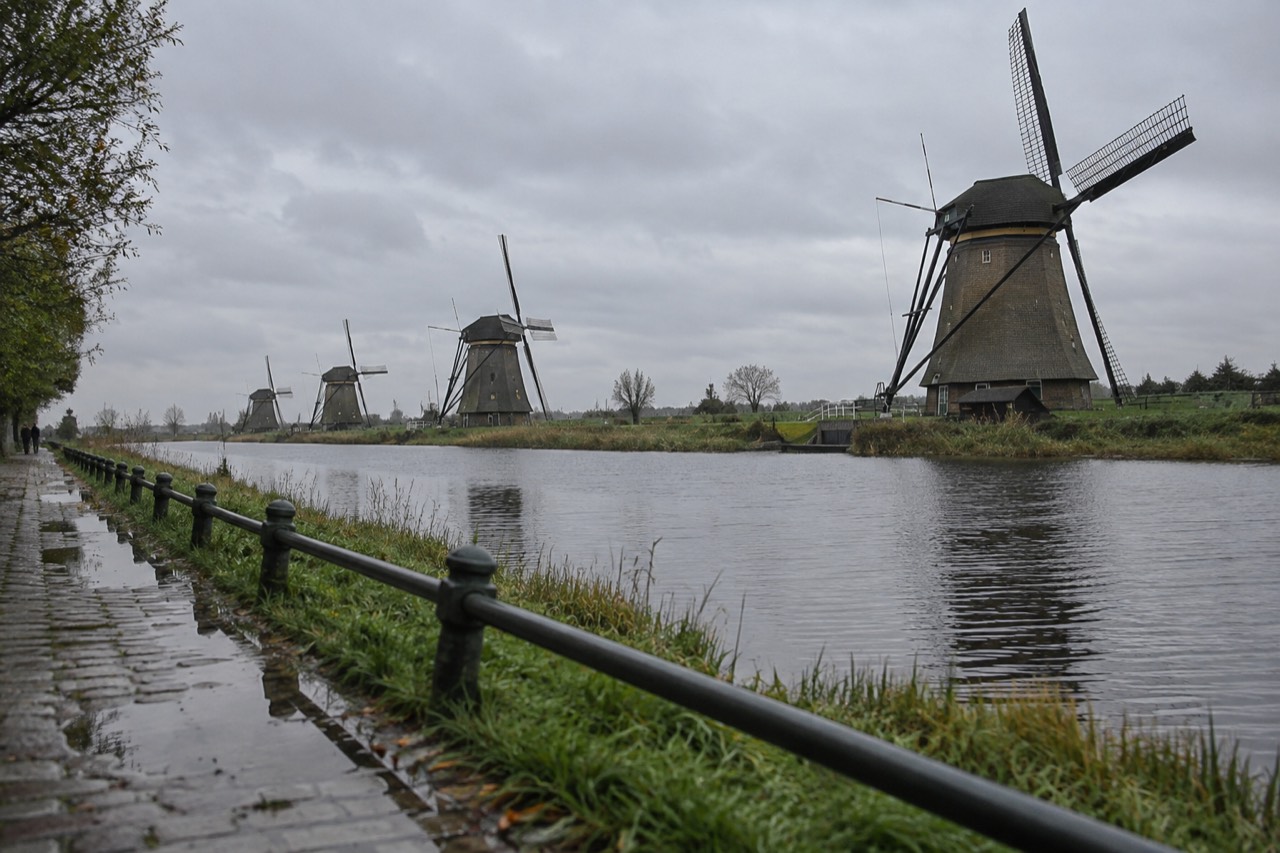
Kinderdijk is a working drainage system turned open-air monument: a long row of historic windmills stands in two lines along the water, still pumping the polder, and the visit is a long, flat walk or boat ride between them. There are no shops, demonstrations or distractions, just mills, reeds, water and sky. It is quiet, photogenic and completely unlike a theme park.
The site sits in the Alblasserwaard polder, south of Rotterdam, and its mills are not decorative. They were built to keep the low-lying land dry, and the drainage function continues today, handed between wind power, steam, diesel and modern pumps as technology changed. That continuity is why UNESCO listed the site. When you stand on the path between the two mill rows, you are looking at a piece of engineering history that never stopped working.
The visit itself is simple. You walk the embankments, you cross the small bridges, and if a mill is open you can step inside to see the miller's living quarters and the turning mechanism. Several mills along the Nederwaard side are open to visitors in the main season, and the visitor centre at the entrance explains the drainage story with models and displays. A boat ride along the canal is the other way to see the line of mills, and it is the view most photographers want, since it puts the full row in frame from the water.
What Kinderdijk does not offer is variety. There is a café and a small shop at the entrance, and beyond that the experience is the landscape. Children under about ten can find the walk long and the story abstract, and the site has little to break up the walking. The reward for that austerity is atmosphere: on a weekday morning in spring or autumn, with mist on the water and the sails turning slowly, it is one of the most quietly impressive sights in the Netherlands. Our full Kinderdijk day trip guide covers the site, the boat ride and the surrounding polder in detail.
What Is Zaanse Schans Actually Like?
Zaanse Schans is a heritage village on the Zaan river with a row of working windmills, wooden houses, a cheese farm, a clog workshop and a bakery, all walkable in a loop of an hour or two. It is compact, commercial and undeniably touristy, and it is also the most efficient way to see Dutch windmills working without giving up a whole day.
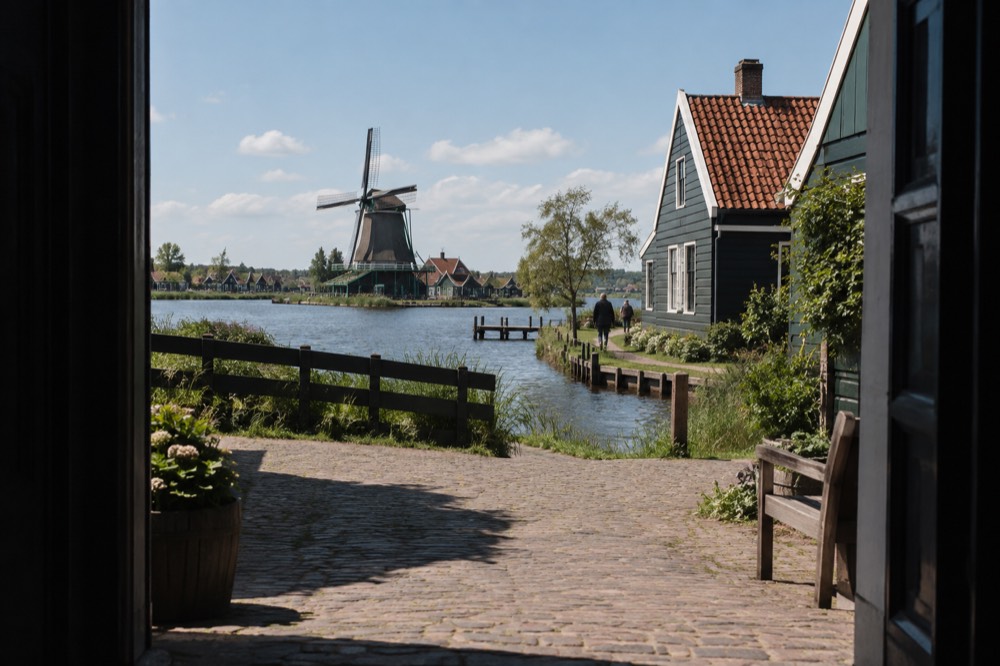
The site was assembled from historic buildings relocated from across the Zaanstreek to preserve them, and a small number of people still live among the green wooden houses. The windmills along the dike are genuine working mills: a dye mill, an oil mill, a sawmill and a spice mill among them, several of which can be entered for a look at the machinery and the miller at work. The variety is the point. Where Kinderdijk gives you one magnificent thing repeated over a long stretch, Zaanse Schans gives you five or six related things in one visit.
The commercial layer is the part reviewers argue about. There is a cheese farm with free tastings, a clog workshop with demonstrations, a bakery famous for its warm honey cake, a clock museum, a distillery and a shop or three selling the usual Dutch souvenirs. If that sounds like a tourist trap, the fair counterpoint is that every element is a real working craft, and the tastings are genuinely free. Travellers who arrive expecting wilderness come away disappointed; travellers who arrive expecting a living museum village tend to enjoy it a lot.
A guided tour takes the friction out of the visit, and the small-group option is the one that fits the site best. The Zaanse Schans windmills, clogs and cheese small-group tour runs 3 hours 30 minutes, is rated 4.7 across 2,868 reviews, and costs from $50, with round-trip transfers from Amsterdam included. It pairs the windmill row with a cheese farm tasting and a clog-making demonstration, which is essentially the site's whole offer organised for you.
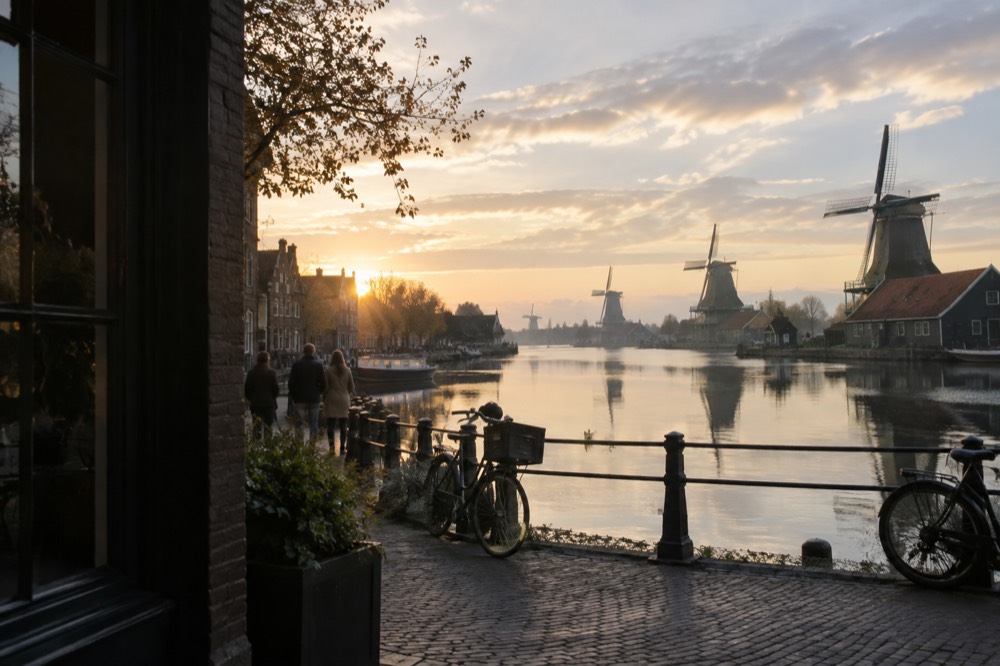
The village also photographs well, particularly from the far bank of the Zaan, where the full row of mills lines up against the water. Early morning and late afternoon both work in your favour here, both for the light and for the crowds, which build sharply from late morning onward when the coach groups arrive. Our Zaanse Schans guide covers the individual mills, the craft workshops and the walking route in full.
Which Is Easier To Reach From Amsterdam?
Zaanse Schans is the clear winner on logistics: it lies a short train ride from Amsterdam Centraal with a station within walking distance of the village, and guided tours run there daily from the city centre. Kinderdijk sits near Rotterdam, roughly an hour and a half away by public transport, and the journey usually involves a train to Rotterdam and a connection onwards.
The Zaanse Schans journey is simple enough to do independently. You board a train from Amsterdam Centraal towards the Zaanstreek and get off at the station for the village, from which the mills are a short walk along a signposted path. Trains run frequently through the day, and the whole transfer takes well under an hour each way, which is why the site works as a half-day trip. Cyclists have an even better option: the route out of Amsterdam along the Zaan is flat, dedicated and scenic, and bike-and-train combinations let you ride one way and rail the other. Other pages covering the same trip are gathered on Things to Do in Amsterdam.
Kinderdijk is a different commitment. The site lies in the polder east of Dordrecht and south of Rotterdam, so the rail journey from Amsterdam runs to Rotterdam first, with a further connection towards the site from there. Count on the better part of two hours each way by public transport, which turns the visit into a full day once you include the walking. That travel time is exactly why the guided day-trip market exists for Kinderdijk, and why independent travellers often pair it with time in Rotterdam rather than returning straight to Amsterdam.
The choice of transport also changes the character of the day. The train to Zaanse Schans passes through ordinary Dutch towns, and the walk from the station delivers you into the village within minutes, keeping the whole outing low-stakes. The journey to Kinderdijk is a commitment, and once you have made it, the temptation is to slow down and walk the full length of the site, which is arguably the correct way to see it. For a deeper look at the city you would be passing through, our Rotterdam guide covers the port city that anchors the southern half of that route.
How Much Do Kinderdijk and Zaanse Schans Cost?
A Zaanse Schans day is the cheaper of the two: guided tours from Amsterdam start at $34, and the independent train fare is modest. Kinderdijk costs more in time than money, with no direct tour on the Amsterdam roster, so most travellers reach it by rail and pay entry at the site. Expect windmill-site entry fees to be checked at the gate, not quoted here, since site pricing sits outside the tour roster.
The tour prices below are the fixed reference points, taken from the live listings. Everything else, including site entry fees, boat rides at the mills and café spending, varies and should be confirmed on the official sites before you go.
| Tour | Duration | Rating | Reviews | From |
|---|---|---|---|---|
| Zaanse Schans, Volendam and Marken guided tour | 5 hours 30 minutes | 4.5 | 20,839 | $34 |
| Zaanse Schans windmills, clogs and cheese small-group tour | 3 hours 30 minutes | 4.7 | 2,868 | $50 |
| Zaanse Schans, Edam, Volendam and Marken tour | 6 hours 30 minutes | 4.8 | 5,559 | $45 |
| Rotterdam, Delft and The Hague guided day tour | 9 hours | 4.2 | 2,642 | $63 |
Read that table as a menu of time budgets as much as prices. The 5 hours 30 minutes option at $34 is the value pick: it bundles the windmill village with the fishing villages of Volendam and Marken on the former Zuiderzee coast, which turns a windmill visit into a full Dutch countryside day. The 3 hours 30 minutes small-group tour at $50 is the depth pick, spending its whole budget on Zaanse Schans itself. The Rotterdam, Delft and The Hague tour at $63 is the one to study if Kinderdijk is your true goal, since it heads south towards the region the mills sit in, though the listing's exact stops should be checked before you book it as a Kinderdijk substitute.
The most reviewed Zaanse Schans product on the roster is the village-plus-Volendam-and-Marken combination, rated 4.5 across 20,839 reviews, and its review volume says something useful: this is the windmill day most visitors actually take, and the satisfaction level is consistently high for a mass-market product.
For Kinderdijk, the honest cost advice is different. Because the site is not on the Amsterdam tour roster, you are paying for a train to Rotterdam, a regional connection, site entry and optionally the boat, and the real currency you spend is the two hours of travel in each direction. Budget travellers can trim that by combining Kinderdijk with a Rotterdam visit on the same rail ticket rather than making it an out-and-back dash.
The comparison table below puts the two sites side by side on the factors that decide the day. It is a planning summary, not a scorecard: both sites are excellent at what they do, and the right answer depends entirely on your time budget and temperament.
| Factor | Kinderdijk | Zaanse Schans |
|---|---|---|
| Travel time from Amsterdam | Roughly 2 hours each way by public transport | Under an hour each way by train |
| Best tour from the roster | None direct; reach by rail via Rotterdam | Guided tours from $34 |
| Scale of the site | Large, spread along long walking paths | Compact, walkable loop |
| Beyond the windmills | Visitor centre, café, boat ride | Cheese farm, clog workshop, bakery, museums |
| Best for | Photographers, slow travellers, full-day plans | Families, first-timers, half-day plans |
Can You Combine a Windmill Day With a Museum Evening?
Yes, and it is the most underused trick in Amsterdam planning. Zaanse Schans tours return by mid-afternoon, the Van Gogh Museum keeps late hours on Fridays, and the Rijksmuseum runs until 17:00 daily, so a windmill morning and a museum evening fit in one day without rushing either.
The mechanics work in your favour. The short Zaanse Schans tours are back in the city centre by early afternoon, which leaves time to eat, rest and still reach a museum for a late entry. The Van Gogh Museum is the natural pairing: it is the most reviewed product on the whole Amsterdam roster, rated 4.7 across 57,096 reviews, with pre-booked timed tickets from $31. Every visitor needs a timed entry ticket booked in advance, so the one planning step that matters is reserving your evening slot before you leave for the windmills, not after you get back tired.
The Heineken Experience is the looser, more social version of the same evening, rated 4.6 across 39,581 reviews from $23, and it sits close enough to the museum quarter to walk between them. A canal cruise is the third option, and the classic saloon boat cruise, rated 4.8 across 33,435 reviews from $19.56, runs on the hour through the evening, which makes it the flexible choice when you cannot predict exactly when your legs will give out. The pairing logic is simple: windmills are a morning activity everywhere in the Netherlands, and Amsterdam's museums and cruises are evening activities, so the two halves of the day do not compete for the same hours.
One planning note for spring travellers: the tulip season around Keukenhof, 19 March to 10 May, overlaps the best weather window for both windmill sites, and the combination of a windmill day plus a garden day plus a museum evening is the point at which advance booking stops being optional. The city's own visitor forecast shows overnight stays still climbing, and the windmill villages feel that growth in their coach parks. The official How to Amsterdam visitor guidance is worth a read before any countryside day trip, since the respect rules that apply in the city extend to how tour groups move through small villages.
Which One Should You Actually Pick?
Pick Zaanse Schans if you have one day, children, or a schedule that also wants Amsterdam's museums and food. Pick Kinderdijk if you have a spare full day, a car or a Rotterdam plan, and a camera. Pick both only if you have four or more days in the Netherlands, because after one windmill site the second is a variation, not a revelation.
The single-day traveller should not agonise. Zaanse Schans from Amsterdam is shorter to reach, cheaper on a tour, easier to do independently, and gives a broader slice of Dutch heritage in a smaller time box. It is the answer to the question for the majority of visitors, and its 20,839-review flagship tour exists precisely because that is true. The failure mode is arriving at midday expecting tranquillity, and the fix is simply going early.
Kinderdijk earns its place when the day is about the landscape itself. A long row of mills in working order, in their original positions, with UNESCO recognition and almost no commerce, is a genuinely rare thing in Europe, and the travellers who regret choosing it are the ones who arrived expecting entertainment rather than scale. Pair it with Rotterdam, go early or go in the shoulder season, and treat the journey as part of the day rather than a cost of it.
The both-in-one-day plan deserves a warning. It is technically possible with a car, but it turns two atmospheric visits into a driving schedule, and the reviews of that approach are consistently poor. If you have the time, give Kinderdijk a full unhurried day and let Zaanse Schans fill a different morning, ideally one that ends with a museum evening back in the city. Whatever you choose, the windmill half of the Netherlands is the half most visitors remember longest, and either site will show you why the country built them in the first place.
Common Questions About Kinderdijk vs Zaanse Schans
Which Is Better To Visit, Kinderdijk Or Zaanse Schans?
Zaanse Schans for most travellers: it is closer to Amsterdam, cheaper to reach, and combines working windmills with cheese, clogs and craft workshops. Kinderdijk if you want the larger, quieter, UNESCO-listed windmill network and can spare the extra travel time.
Can you visit Kinderdijk and Zaanse Schans in one day?
It is possible with a car but not recommended. The two sites are far apart, and rushing both turns each into a photo stop. Give Zaanse Schans a half-day or Kinderdijk a full day instead.
How do you get to Zaanse Schans from Amsterdam?
A short train ride from Amsterdam Centraal towards the Zaanstreek, with a station within walking distance of the village. Guided tours with transfers from the city also run daily, from $34.
Is Kinderdijk worth the trip from Amsterdam?
Yes, if you have a spare full day and enjoy landscape over activity. The historic windmills still drain the polder, and the site is UNESCO-listed. If your time is short, Zaanse Schans delivers a similar experience in half the travel.
Are the Zaanse Schans windmills real working mills?
Yes. The mills along the dike include a dye mill, an oil mill, a sawmill and a spice mill, several of which can be entered to see the machinery and the miller at work.
Which windmill site is better with children?
Zaanse Schans. The cheese tastings, clog demonstrations, bakery and short walking loop hold a child's attention, while Kinderdijk's long flat walks and abstract drainage story suit older visitors better.