Magere Brug Amsterdam: Visiting the Skinny Bridge
The Magere Brug is the most photographed wooden bridge in Amsterdam, a pale double bascule crossing the Amstel that opens for tall boats and glows with hundreds of lights after dark. This guide covers how to reach it, what to look at from the middle, and how to fold it into a canal cruise or an evening walk.
Short answer
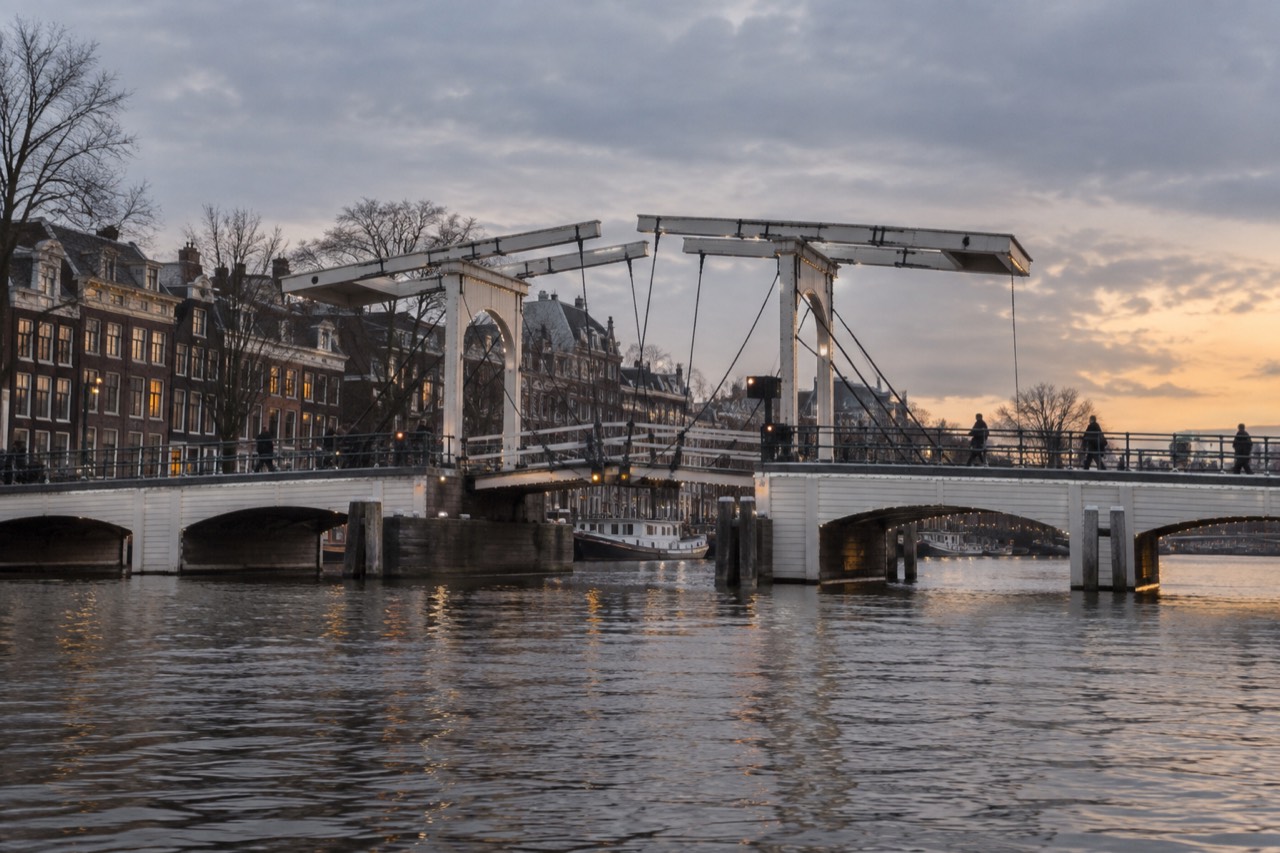
The Magere Brug, or Skinny Bridge, is a white wooden double drawbridge over the Amstel river, a short walk east of the Rijksmuseum. It is free to visit at any hour, opens to let tall vessels pass, and is lit by strings of lights every evening. A one-hour canal cruise from about €15.50 gives you the classic view from the water.
Amsterdam has hundreds of bridges, but only one that people cross on purpose rather than because it happens to be in the way. The Magere Brug, the "skinny bridge" in Dutch, is a pale timber drawbridge spanning the Amstel river at the point where the water is widest, and it has become one of the defining images of the city: white timber, black cast-iron railings, twin leaves that lift apart for masted boats. This page, part of Things to Do in Amsterdam, covers everything a visitor needs: where it is, how to get there on tram or foot, when the light is best, which cruises pass beneath it, and what to see within a few minutes' walk on either bank.
What Is the Magere Brug and Why Is It Called the Skinny Bridge?
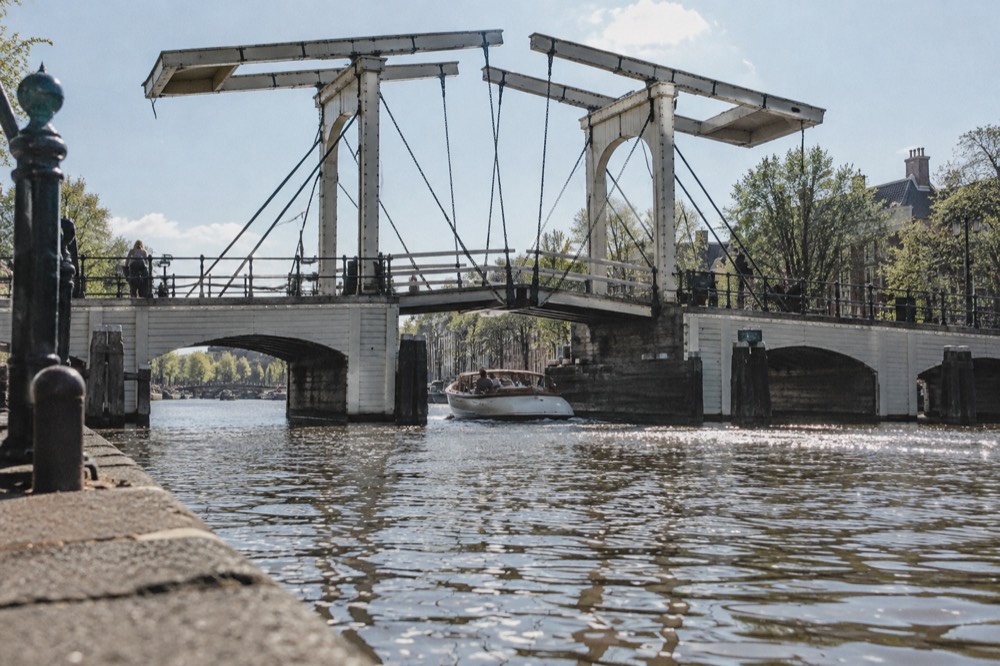
The Magere Brug is a wooden double bascule bridge across the Amstel river, linking the Kerkstraat on the centre side with the Nieuwe Kerkstraat on the eastern bank. Its name means "skinny bridge" in Dutch and refers to an earlier, much narrower crossing at the same spot, while today's wider reconstruction keeps the traditional style and still opens as a working drawbridge for tall vessels.
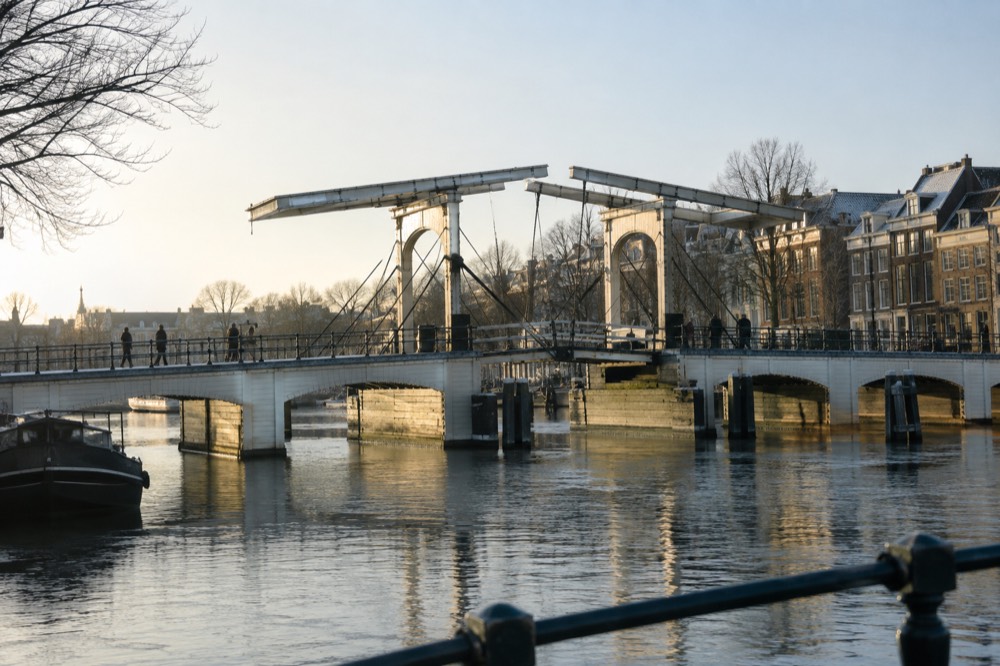
The story behind the name is a good one, even if the archives cannot fully vouch for it. Local tradition says a pair of sisters lived on opposite sides of the Amstel and had a narrow footbridge built so they could visit each other more easily, hence "mager", skinny. Whatever the truth of the sisters, the crossing itself is genuinely old: a bridge has stood here since the late seventeenth century, when the Kerkstraat was laid out. The narrow wooden version the name describes served until the late nineteenth century, when traffic demands outgrew it.
The bridge you cross today is a deliberate act of nostalgia. When the city replaced the old structure, it chose to rebuild in the historic idiom rather than in steel, keeping the white-painted timber, the wooden deck and the hand-cranked appearance of a traditional Dutch drawbridge. It is a working bascule bridge with two leaves that swing up from opposite banks, and it still opens on request for sailing boats and other tall craft passing along the Amstel. Watching the leaves rise is one of the small free theatre moments Amsterdam does well, and in sailing season you have a decent chance of catching it.
What makes it photograph so well is the setting rather than the structure alone. The Amstel is the widest stretch of open water in the centre, so the bridge reads against a long view rather than a narrow canal slot. Behind it stand gabled houses, mature trees and the tower of a church, and at night the timber carries strings of small lights along its length, a display installed in the 1990s that turned the bridge into an evening landmark. Locals cross it without a glance. Visitors stop in the middle, every single time.
Where Is the Magere Brug and How Do You Get There?
The Magere Brug sits on the Amstel river, roughly midway between the Rijksmuseum and the Royal Theater Carré, about fifteen minutes on foot from Museumplein. From Amsterdam Centraal, trams along the metro and tram network reach the nearest stops in around fifteen minutes, and a single GVB ticket costs €3.40 for one hour of travel. Walking from Dam Square takes about twenty minutes and passes through the canal belt, which is the more pleasant option in good weather.
The bridge connects two modest but pleasant streets: the Kerkstraat on the west bank, a low-rise street of small shops and cafés, and the Nieuwe Kerkstraat on the east side, which continues into the Plantage district. Because the Amstel is wide here, the bridge is visible from a distance along both quays, so navigation is easy: walk toward the river from almost any direction in the south of the centre and you will run into it.
On public transport, the practical options are the trams that stop near the Frederiksplein or the Weesperplein area, both a few minutes from the banks. A single GVB ticket is €3.40 and covers one hour of travel from first tap-in, while a 24-hour day ticket costs €10.00 if you plan to make several trips, per the operator's own fare page. Contactless payment works on trams, buses and metro with a base fare plus a per-kilometre charge and a daily cap, so many visitors never buy a paper ticket at all. If you are coming from the airport, the NS train runs from Schiphol to Amsterdam Centraal in just over seventeen minutes from €5.50, and the bridge is a straightforward tram ride from there.
| Route | How | Rough time | Cost |
|---|---|---|---|
| From Amsterdam Centraal | Tram toward the south of the centre, short walk from the stop | About 15 minutes riding plus a short walk | €3.40 single |
| From Dam Square | On foot through the canal belt | About 20 minutes | Free |
| From Museumplein | On foot past the Rijksmuseum | About 15 minutes | Free |
| From Schiphol Airport | NS train to Centraal, then tram or walk | Just over 17 minutes by train, then onward | From €5.50 train fare |
| By canal cruise | Most Amstel itineraries pass under the bridge | Depends on the cruise route | From about €15.50 |
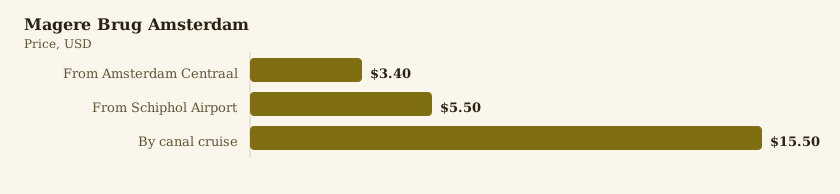
The fare figures above come from the transit operator's published price list and the railway's own booking page, and the cruise figure is the verified operator price for a standard one-hour trip with audio guide. Fares and schedules move, so treat the numbers as a planning range and check the live pages before you travel, particularly if you arrive on a public holiday when service patterns thin out.
If you are building the visit into a first-time itinerary, the natural pairing is a morning at the Rijksmuseum followed by the fifteen-minute walk east to the bridge, then onward along the Amstel. Our Amsterdam for First Time Visitors guide lays out that kind of route in full, and the three days in Amsterdam itinerary gives the bridge a natural slot on day two.
What Can You See From the Magere Brug?
From the middle of the Magere Brug you look along the widest open water in central Amsterdam: upriver toward the Blauwbrug and the Stopera, downriver toward the Amstel locks, and across both quays at rows of gabled houses and moored houseboats. It is one of the few street-level spots in the centre where the skyline opens out and you see the city as a river port rather than a canal maze.
Stand facing upriver, toward the city centre, and the view runs along the Amstel toward the Blauwbrug, a stone bridge with ornate lamp posts that borrowed its look from Parisian bridge architecture. Beyond it rises the complex of the city hall and opera house, known locally as the Stopera. Face the other way and the river widens toward the Amstelsluizen, the locks that control the level where the river meets the canal system, with the towers of the Plantage district behind the trees on the left bank.
The quays themselves reward a slower look. Houseboats moor along both banks, and the houseboat museum a short canal walk away shows what life aboard one is actually like. On the centre side, the Kerkstraat climbs gently away from the bridge, and on the far side the Nieuwe Kerkstraat leads toward the Portuguese Synagogue and the Jewish Cultural Quarter, one of the most atmospheric complexes in the city. None of these are more than a quarter of an hour on foot, which is what makes the bridge such a useful hinge for a walk.
Two practical notes. First, the bridge is a working crossing, not a monument behind a rope: cyclists cross it at speed on the carriageway, so keep to the pedestrian side and do not set a tripod up in the bike lane. Second, the bridge occasionally opens for boat traffic, and when it does the barriers come down for a few minutes. That pause is a feature, not a fault, and it is the best photograph many visitors go home with.
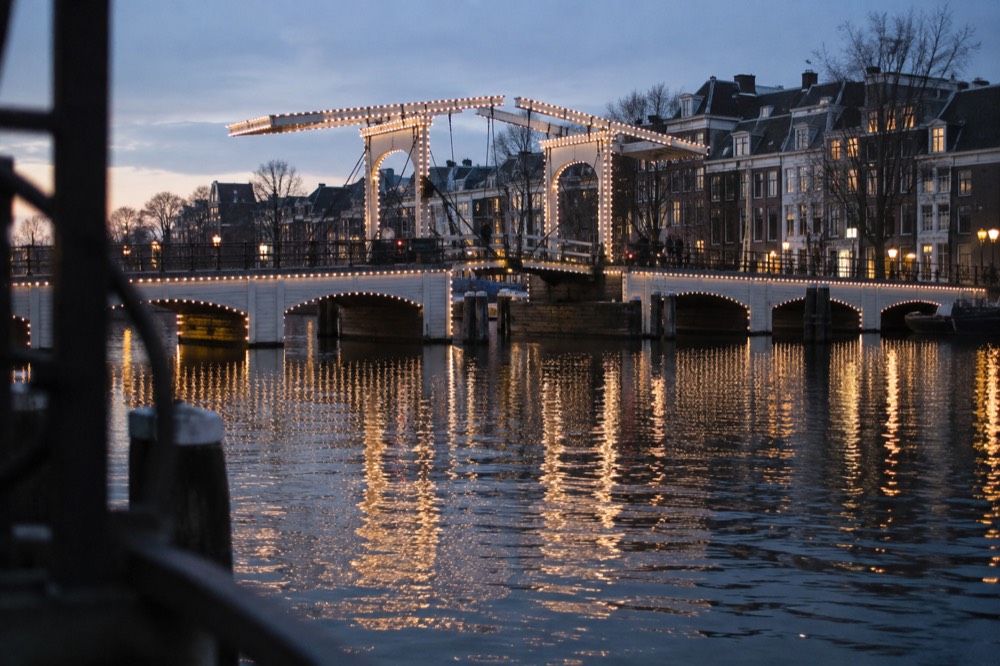
When Is the Best Time to Visit the Magere Brug?
The best time to visit the Magere Brug is the hour around sunset, when the bridge lights switch on and the timber glows against a darkening sky. The lights run every evening year-round and are the reason the bridge appears in so many Amsterdam night photographs. Mornings are quieter, with softer light upriver, and in sailing season you may catch the bridge opening for a tall boat.
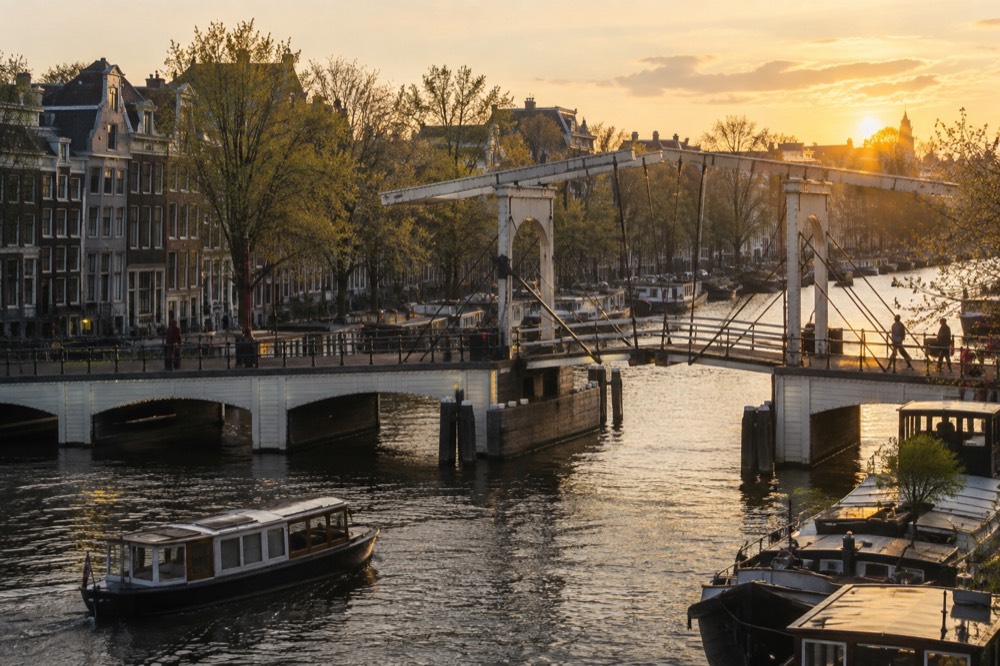
The evening light show is the headline. Hundreds of small bulbs trace the bridge's outline after dark, and they stay lit all night, so late evening works as well as sunset if you want fewer people in the frame. The classic shot is taken from the west quay looking north, with the lights doubled in the water, but any of the four corners gives a workable angle and the river is wide enough that you do not need to be clever about it.
Season changes the mood more than the view. In winter the sun sets early enough that you can see the lit bridge and still be at dinner by half past seven, and the Amsterdam in winter guide on this site covers how to build a whole short trip around that. In spring the quays green up and the sailing boats return, which raises your odds of seeing the leaves lift. Summer evenings are the busiest, with the quay filling up around golden hour, so arrive a little before sunset to claim a spot on the rail.
Which Canal Cruises Pass Under the Skinny Bridge?
Most sightseeing cruises that include the Amstel pass under the Magere Brug, and seeing the bridge from the water is the version of the view most people remember. A standard one-hour cruise costs from about €15.50 with an audio guide, while drinks-inclusive and small-group options run higher. The bridge's clearance is low, so boats either fit beneath the closed leaves or the bridge opens for them.
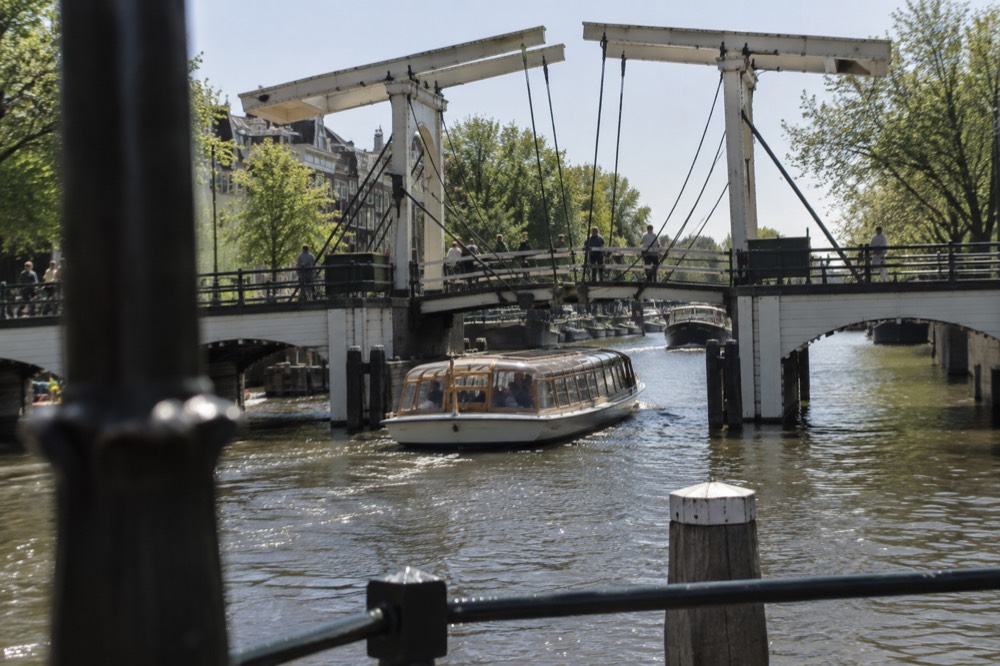
The choice is really about format, not route. The budget end is the classic one-hour sightseeing loop with recorded commentary in many languages, departing from piers along the Damrak and near the Rijksmuseum. A step up buys you a live guide, a smaller boat and a drink, and the premium end is the small open sloop with an open bar and Dutch snacks, which turns the hour into something closer to a floating café. The Amsterdam boat rental and private canal boats guide on this site covers the option of driving yourself, which also puts the bridge on your own route.
| Cruise type | Typical duration | What you get | Price level |
|---|---|---|---|
| Standard one-hour cruise | 1 hour | Audio guide, covered boat, fixed route | From about €15.50 |
| Classic saloon boat | 1 hour | Historic wooden vessel, live guide, drinks and cheese option | From $19.56 |
| Evening city lights cruise | 1 hour 30 minutes | Illuminated canals and Amstel after dark | From $21 |
| Small-group sloop with snacks | 2 hours | Open boat, open bar, Dutch snacks, skipper-guide | From $71.09 |
If the bridge is your main target, book an evening departure. The Amstel is where the lit bridges cluster, and a cruise that reaches the river after dark strings together the Magere Brug, the Blauwbrug and the illuminated quays in one loop. Check the route description on the live listing before you book, because not every one-hour cruise reaches the Amstel; some stick to the smaller canal ring, which is lovely but never gets you here.
What Is Near the Magere Brug?
Within fifteen minutes' walk of the Magere Brug you can reach the Rijksmuseum, the Royal Theater Carré, the Jewish Cultural Quarter with the Portuguese Synagogue, and the H'ART Museum. The bridge sits in the gap between the museum district and the Plantage, which makes it one of the best-positioned free sights in the city. Most visitors fold it into a museum morning or an evening walk along the Amstel rather than visiting it on its own.
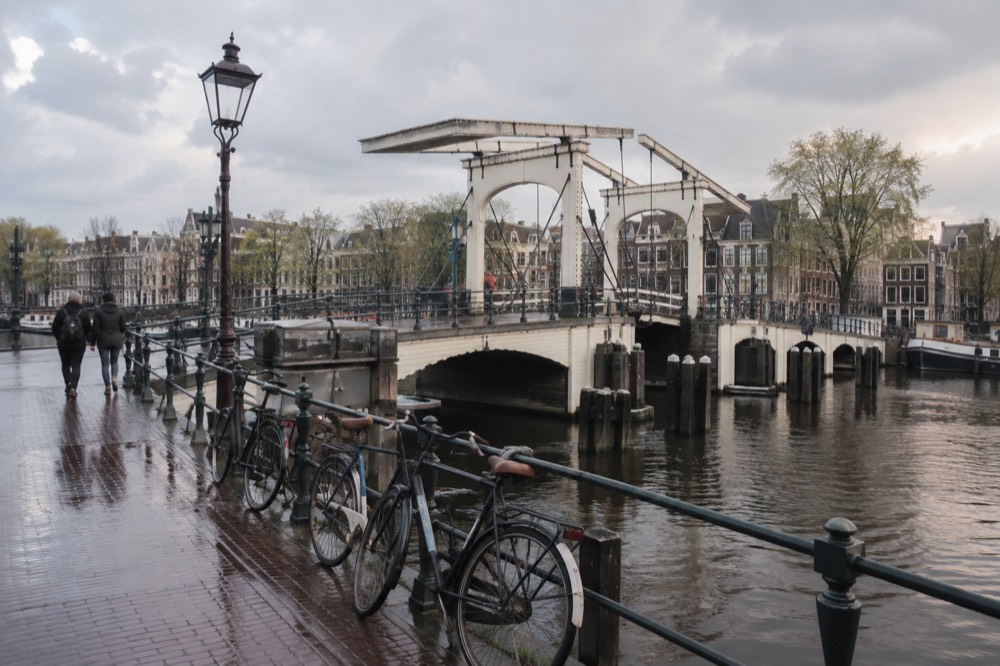
The nearest heavyweight attraction is the Rijksmuseum, whose tower you can see from the bridge's western approach. Adult admission is €25, free for ages 18 and under, and every visitor needs a pre-booked start time, including pass holders, according to the museum's own visit page. It opens daily from 9am to 5pm including public holidays. The Rijksmuseum guide on this site covers how to time a visit around the crowds.
On the east bank, the Plantage district holds the H'ART Museum and, a little further, the ARTIS Royal Zoo and the Hortus Botanicus, the city's botanical garden. South along the river, the theater Carré hosts musicals and concerts, and the Weesperzijde quay on the east bank is one of the nicer riverside walks in the city, quieter than anything in the canal ring.
| Attraction | Direction from the bridge | Admission notes |
|---|---|---|
| Rijksmuseum | West, about 15 minutes on foot | €25 adults, free 18 and under, timed entry required |
| Portuguese Synagogue | East, about 15 minutes on foot | Part of the Jewish Cultural Quarter ticket |
| H'ART Museum | East, about 10 minutes on foot | Check the operator's own site for current prices |
| ARTIS Royal Zoo | East, about 20 minutes on foot | Dynamic pricing, always cheaper online |
| De Gooyer windmill | North-east, about 20 minutes on foot | Free to view from the street |
A note on the prices in that table: the Rijksmuseum figure comes from the museum's own published page, while several other nearby sites do not publish a verified current price in the sources this desk checks, so the honest instruction is to confirm on the operator's own site before you budget. That is deliberate. A page that invents a price to fill a table is worse than one that tells you to look it up.
How Do You Photograph the Magere Brug Well?
The strongest photographs of the Magere Brug are taken from the west quay after dark, with the bridge lights on and their reflection running across the Amstel, or from a boat passing beneath the leaves during the day. You do not need special equipment: a phone handles the lit bridge if you steady it on the railing, and the wide river means no clever angles are required.
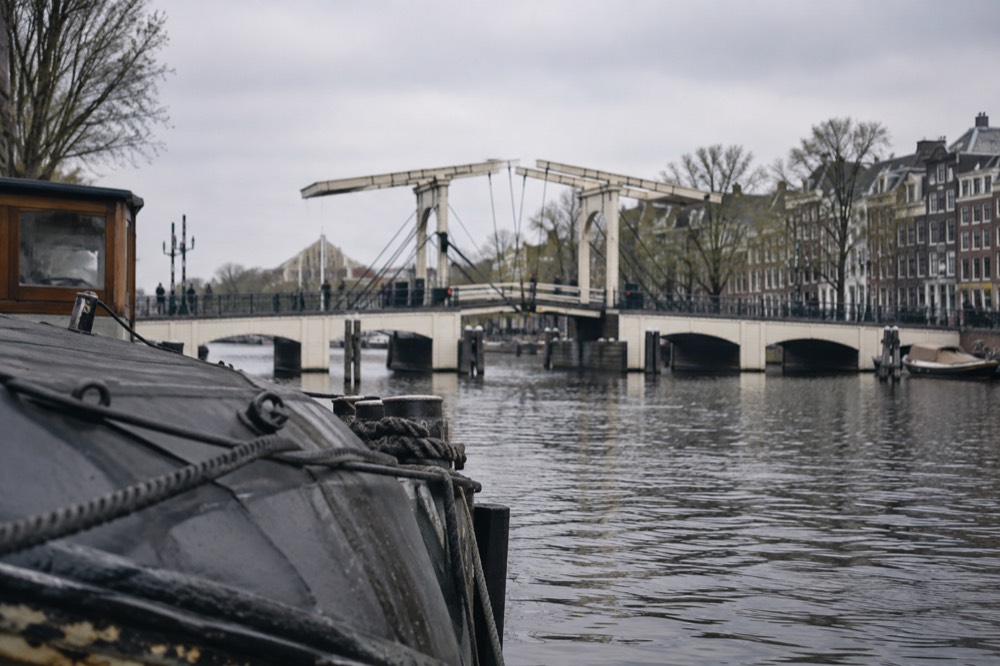
Daytime gives you the structure: white timber against blue water, the black railings making a strong graphic frame, and if you are patient, the leaves opening for a sailboat. The opening is unpredictable, so treat it as a bonus rather than a plan. From the water, a cruise that passes under the bridge gives you the low-angle view of the underside of the leaves, which is the shot nobody standing on the quay can get.
After dark, the strings of lights do most of the work for you. Arrive twenty minutes before sunset, pick your spot on the west side, and let the sky darken around the lit structure. A long exposure smooths the water and doubles the reflection, but a steady hand on the railing captures plenty. The Amsterdam photography spots guide on this site places the bridge in a full route of photogenic locations, several of which are within the same evening walk.
One etiquette point that matters more than any camera setting: the bridge is a working crossing in a residential neighbourhood. Keep off the bike lane, do not block the deck for group shots, and if the barriers come down for an opening, stay behind them. The city's own visitor guidance asks for exactly this kind of consideration across the centre, and the bridge is where residents feel it most.
Can You Combine the Skinny Bridge With a Museum Day?
Yes, and it is one of the easiest combinations in Amsterdam. The Magere Brug sits about fifteen minutes on foot from Museumplein, so a morning in the Van Gogh Museum or the Rijksmuseum flows naturally into an afternoon walk across the bridge and along the Amstel. Both museums use timed entry and both cost €25 for adults, with under-18s free, so book start times in advance and let the walk fill the gap between slots.
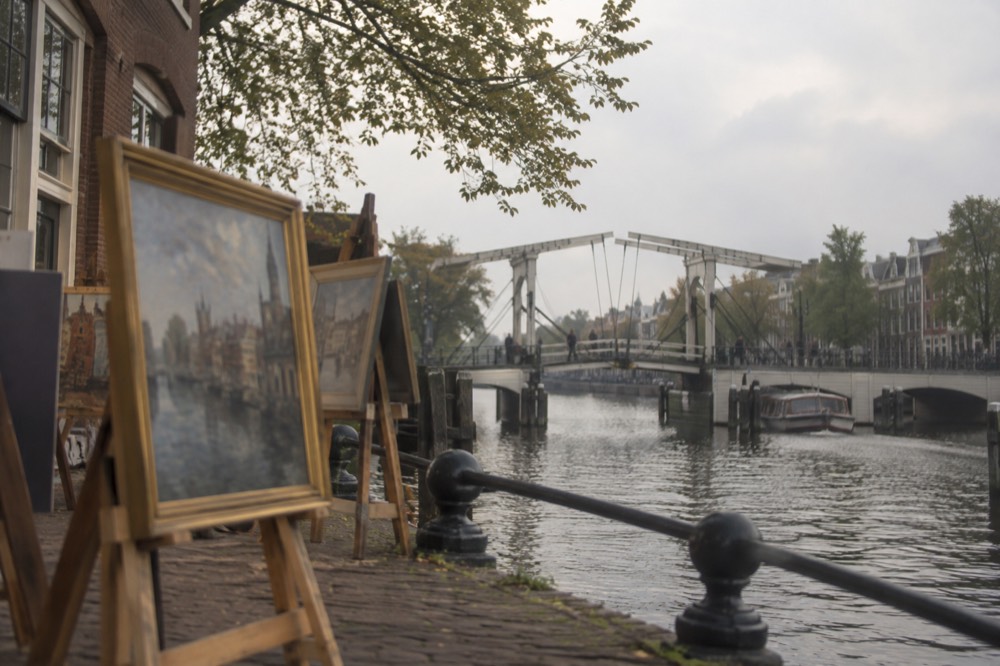
The Van Gogh Museum requires every visitor to pre-book a timed ticket, and it is not included in the I amsterdam City Card, so it needs its own booking regardless of any pass you hold. The Rijksmuseum is included in that card, but still requires a booked start time. That combination of facts catches out a lot of visitors: a pass does not remove the booking step, it only removes the price. The Amsterdam museum tickets and skipping the queue guide on this site goes through the mechanics museum by museum.
A sensible day runs like this: book the Rijksmuseum for opening at 9am, give it three hours, walk east along the Kerkstraat to the bridge, cross it, and continue into the Plantage for lunch. The afternoon can take in the H'ART Museum or the Portuguese Synagogue, and the evening walk back along the Amstel catches the bridge lights at their best. You end where you started, and you have seen both halves of the river city in one loop.
Common Questions About the Magere Brug
Is the Magere Brug free to visit?
Yes. It is a public street bridge with no ticket, no gate and no closing time. You can cross it at any hour, and the evening light display costs nothing to watch from the quays.
Why is it called the Skinny Bridge?
The Dutch name means "skinny bridge" and refers to an earlier, much narrower crossing at the same spot, traditionally linked to a story about two sisters who lived on opposite banks. The current bridge is a wider historic-style reconstruction, but the old name stuck.
Does the Magere Brug still open for boats?
Yes. It is a working double bascule bridge whose two leaves lift for tall vessels on the Amstel, mainly sailing boats in the warmer months. When it opens, barriers stop foot and bike traffic for a few minutes.
When do the bridge lights come on?
The strings of lights along the timber are lit every evening and stay on through the night, so the lit bridge is visible from dusk onward year-round. The best photographs come in the half hour after sunset.
How far is the Magere Brug from the Rijksmuseum?
About fifteen minutes on foot, walking east along the Kerkstraat from the museum's rear side. The bridge sits roughly midway between the Rijksmuseum and the Plantage district on the east bank of the Amstel.
Do canal cruises pass under the Skinny Bridge?
Most cruises whose route includes the Amstel pass under it, and several evening cruises are built around the lit bridges along this stretch. Check the route description on the live listing before booking, because some shorter loops stay in the canal ring and never reach the river.