Stedelijk Museum Amsterdam: A Practical Visitor Guide
The Stedelijk Museum is Amsterdam's home of modern and contemporary art and design, sitting between the Rijksmuseum and the Van Gogh Museum on the Museumplein. This guide covers what it holds, what a ticket costs, how it compares with its neighbours, and how to plan the visit.
Short answer
The Stedelijk Museum is Amsterdam's museum of modern and contemporary art and design, located on the Museumplein between the Rijksmuseum and the Van Gogh Museum. A skip-the-line entry ticket starts at $26 per person and is rated 4.4 across 1,850 reviews. The Museumkaart and the I amsterdam City Card both cover entry.
Amsterdam keeps its three most visited museums on one square, and the Stedelijk Museum is the third corner of that triangle. The Rijksmuseum holds the Golden Age, the Van Gogh Museum holds one painter, and the Stedelijk holds everything after them: the modern and contemporary art and design movements that arrived once the old masters had already been framed and hung. For visitors it is the least obvious of the three, and often the least crowded, which is exactly why it deserves a slot in the itinerary. This guide, part of our coverage of Things to Do in Amsterdam, walks through what the museum holds, what a ticket costs, and how to fit it into a Museumplein day.
What Is the Stedelijk Museum Amsterdam?
The Stedelijk Museum is Amsterdam's premier museum of modern and contemporary art and design, located on the Museumplein directly beside the Van Gogh Museum and the Rijksmuseum. Its collection runs from late nineteenth-century painting through to present-day digital and immersive work, and a ticket is rated 4.4 across 1,850 reviews on the live listing. It is the institution that fills the gap between the two older museums around it, and it does so across painting, sculpture, photography, film, graphic work and industrial design rather than a single national period.
The museum's own framing, on its ticket listing, is that it is the Netherlands' premier destination for modern and contemporary art and design. That is not an idle claim on this square. The Rijksmuseum stops broadly at the nineteenth century, the Van Gogh Museum covers one decade of one artist, and the Stedelijk picks up the century that follows. Visitors who want Picasso-era abstraction, De Stijl, postwar American painting, or contemporary video and installation work will find those movements here rather than across the plaza.
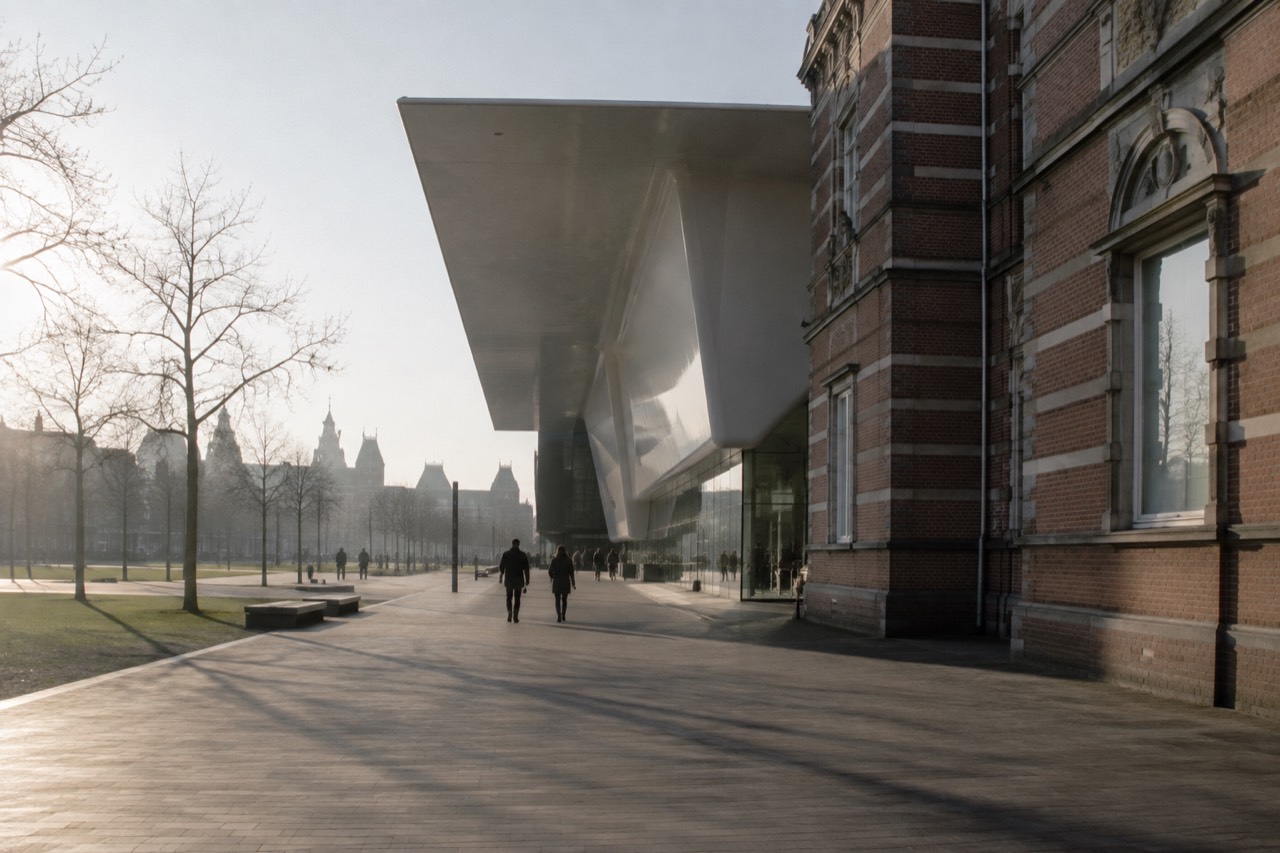
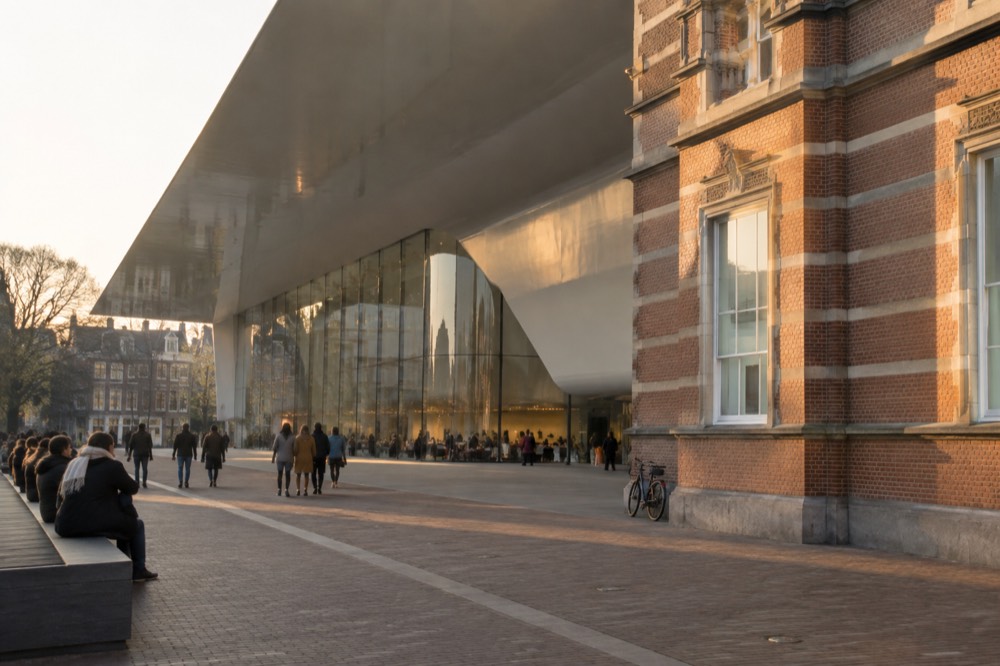
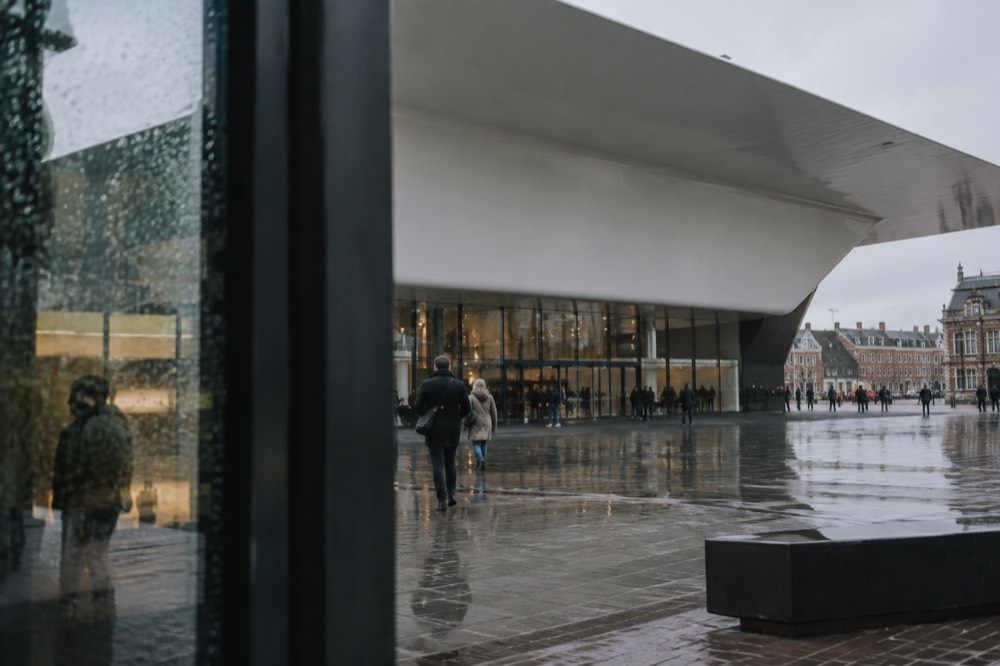
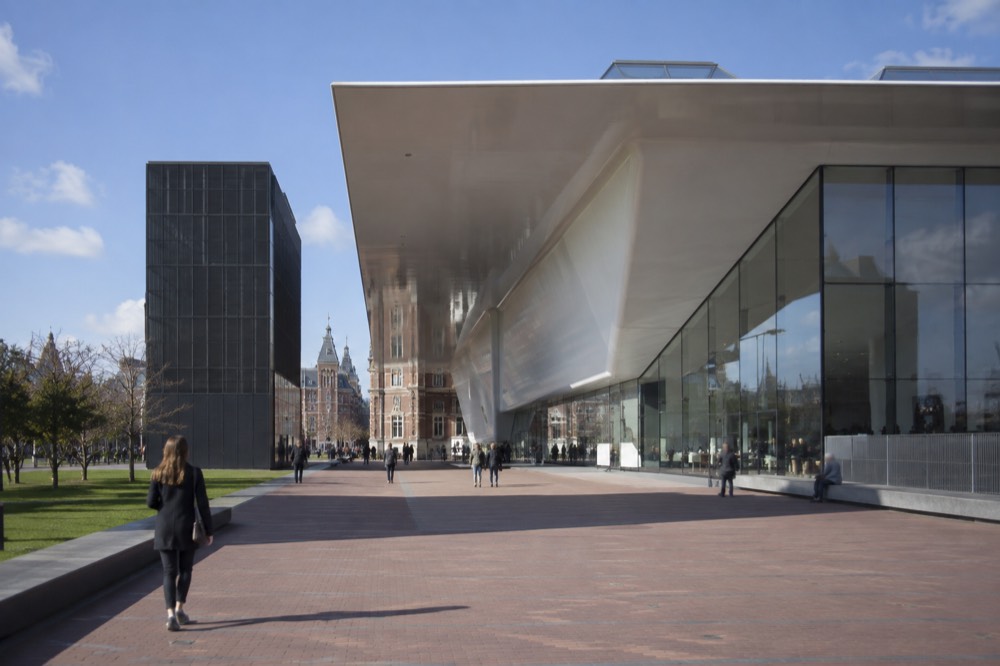
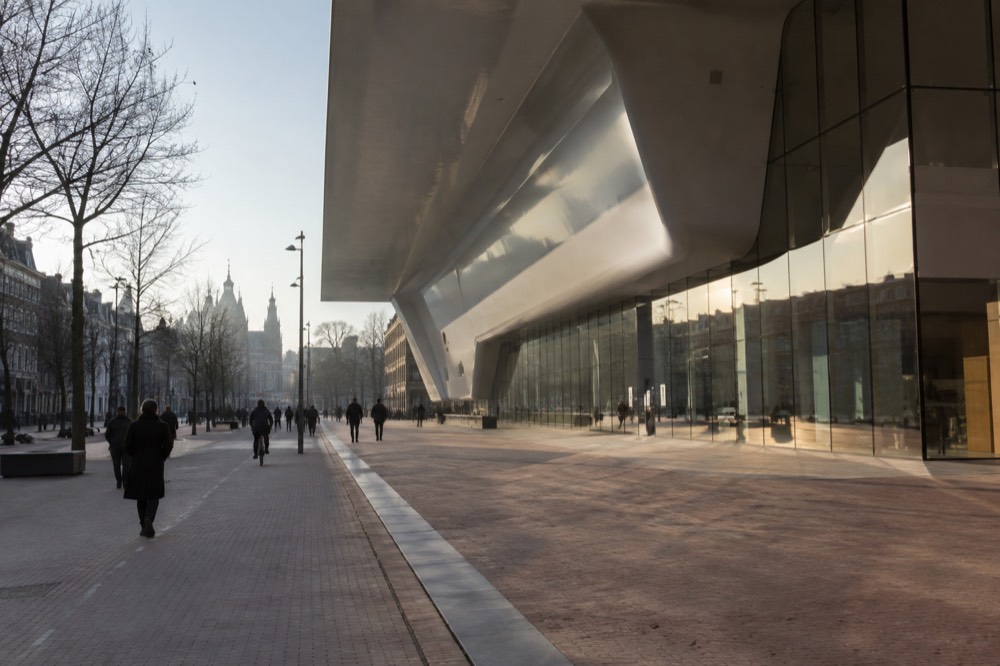
The building itself is part of the experience. The original brick structure dates from the late nineteenth century, and its modern extension, a white volume popularly compared to a bathtub, opened in 2012 after years of renovation controversy. The contrast between the two halves mirrors the collection inside: a historic shell holding a century of rupture. The entrance hall, the shop and the café sit in the seam between old and new.
For trip planning, the practical point is simple. The Stedelijk is not a half-day museum in the way the Rijksmuseum can be. Its galleries are navigable in roughly two hours for most visitors, which makes it the natural late-morning or mid-afternoon stop between its two heavier neighbours. The ticket listing gives the visit duration as two hours to one day, which is honest: two hours covers the permanent collection route, and anyone drawn into the design wing or a temporary exhibition can easily stay longer.
Is the Stedelijk Museum Worth Visiting?
The Stedelijk is worth visiting for anyone with an interest in modern art, design, or contemporary work, and it is the strongest choice on the Museumplein for visitors who find the Golden Age galleries less engaging. It is rated 4.4 across 1,850 reviews, and its two-hour visit length makes it an efficient add-on rather than a competing commitment. The honest answer depends on what a visitor wants from Amsterdam's museum square, and the comparison is worth making plainly.
If the trip is built around Rembrandt and Vermeer, the Stedelijk is the optional third stop. If the trip is built around Van Gogh, the Stedelijk is the natural companion, because it shows what painting did after Van Gogh and how the movements he prefigured, expressionism among them, developed into the twentieth century. And if the visitor cares about design at all, furniture, typography, posters, ceramics, the Stedelijk's design collection is the deepest in the city and has no real rival on the square.
The value calculation also depends on timing. The Van Gogh Museum and the Rijksmuseum both use timed entry and both sell out in peak season; the Stedelijk rarely does. That makes it the flexible stop. A visitor who arrives at the Museumplein at 14:00 with no bookings can usually walk into the Stedelijk within the hour while the other two turn them away. Our guide to a museum day in Amsterdam covers how to sequence all three without exhausting yourself by lunchtime.
There is also a practical middle path worth naming: the free-walking option. Visitors who only want a taste of the square can combine the Stedelijk with the Moco Museum, two minutes away, which holds modern and contemporary work including Banksy, and which carries a 4.3 rating across 11,775 reviews with tickets from $20. The two museums between them cover the modern-and-contemporary appetite at a lower total cost than the full trio.
For a first visit, the three products below are the ones travellers most often combine with a Stedelijk ticket, and they are the sensible starting point for a booking.
How Much Do Stedelijk Museum Tickets Cost?
A skip-the-line Stedelijk Museum entry ticket starts at $26 per person on the live listing, rated 4.4 across 1,850 reviews, with a visit window of two hours to one day. The official door price is not published in our verified research, so treat the listing price as the reliable figure and check the museum's own site for the walk-up rate. That honesty matters: several Amsterdam attraction prices circulate widely online without a primary source, and the Stedelijk's own admission price is one of them.
The booking picture has three layers. First, the resold skip-the-line ticket, which is what the $26 figure above refers to: a timed entry bought in advance, avoiding the counter queue. Second, the official box office, whose current rate we have not verified from the museum's own site, so we will not print a number for it. Third, the passes, which are verified and which change the arithmetic considerably.
| Way in | Cost | Notes |
|---|---|---|
| Skip-the-line ticket via the live listing | From $26.00 | Rated 4.4 across 1,850 reviews; two hours to one day |
| Museumkaart | €75 adults, €39 up to 18 | Annual card, 500+ museums; timed booking may still be required |
| I amsterdam City Card | €67 for 24 hours, €94 for 48 hours | Includes 70+ museums, GVB transport, one canal cruise, a 24-hour bike rental |
| Official box office | Not verified | Check the museum's own site before paying at the counter |
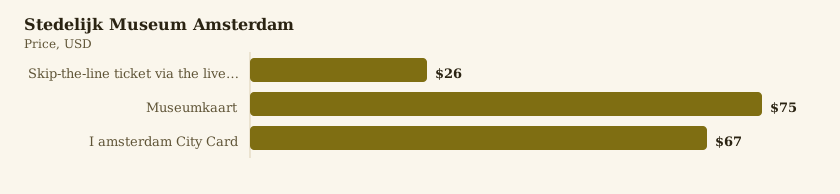
The pass maths is where the Stedelijk earns its keep, because it is included on both major cards while the Van Gogh Museum is included on neither. The Museumkaart costs €75 for adults and €39 for visitors up to age 18, both figures confirmed on a participating museum's own pricing page, and covers more than 500 museums across the Netherlands. A temporary version, valid 31 days for a maximum of 5 visits, is available to visitors without a Dutch address, bought at participating museums and registered online afterwards. The I amsterdam City Card, at €67 for 24 hours and €94 for 48 hours on the verified pricing, includes the Stedelijk alongside unlimited GVB transport, a canal cruise and a bike rental.
Neither card includes the Anne Frank House, which states plainly on its own ticket page that the City Card gives no discount, and neither includes the Van Gogh Museum, which requires a separately pre-booked timed ticket. Our fuller breakdown of the I amsterdam City Card runs the sums for different trip lengths.
If the Stedelijk is the booked stop, the ticket below is the direct one.
How Does the Stedelijk Compare With the Van Gogh Museum?
The Stedelijk covers a century of modern and contemporary art and design, while the Van Gogh Museum covers one artist whose timed tickets sell out first; the Van Gogh ticket costs $31 from, rated 4.7 across 57,096 reviews, versus the Stedelijk's $26 from at 4.4 across 1,850. Choose the Van Gogh if the artist is the reason for the trip, the Stedelijk if breadth or availability matters more. The two museums are a two-minute walk apart, so the real question is sequencing, not choosing.

The Van Gogh Museum is the harder booking. Its own site states that all visitors must pre-book a timed entry ticket, and adult admission is €25, free for under-18s, with hours that vary by month and Friday late nights. Its listing, rated 4.7 across a striking 57,096 reviews, describes over 200 paintings, 500 drawings and more than 750 letters. The Stedelijk has no such bottleneck: it is the walk-up-friendly neighbour, and its collection answers the question the Van Gogh Museum raises, what came next.
For a combined day, the standard sequence works: book the Van Gogh for the first timed slot available, usually a morning one, then cross to the Stedelijk for the middle of the day when the Van Gogh's queues are at their worst. The Rijksmuseum, €25 for adults with free entry under 18 and daily 9am to 5pm opening, can sit on either end. Our Van Gogh Museum guide and our Rijksmuseum guide cover both neighbours in detail.
The Van Gogh ticket is the one to lock in first, and it is the related booking for this page.
What Will You Actually See Inside?
The Stedelijk's collection runs from late nineteenth-century painting through modernism, De Stijl, postwar abstraction and contemporary installation and digital work, with a design wing covering furniture, graphics and industrial design. Two hours covers the permanent collection route comfortably; temporary exhibitions can stretch the visit toward the full day the ticket allows. The museum is best understood as a chronological walk through the art the Rijksmuseum does not show.
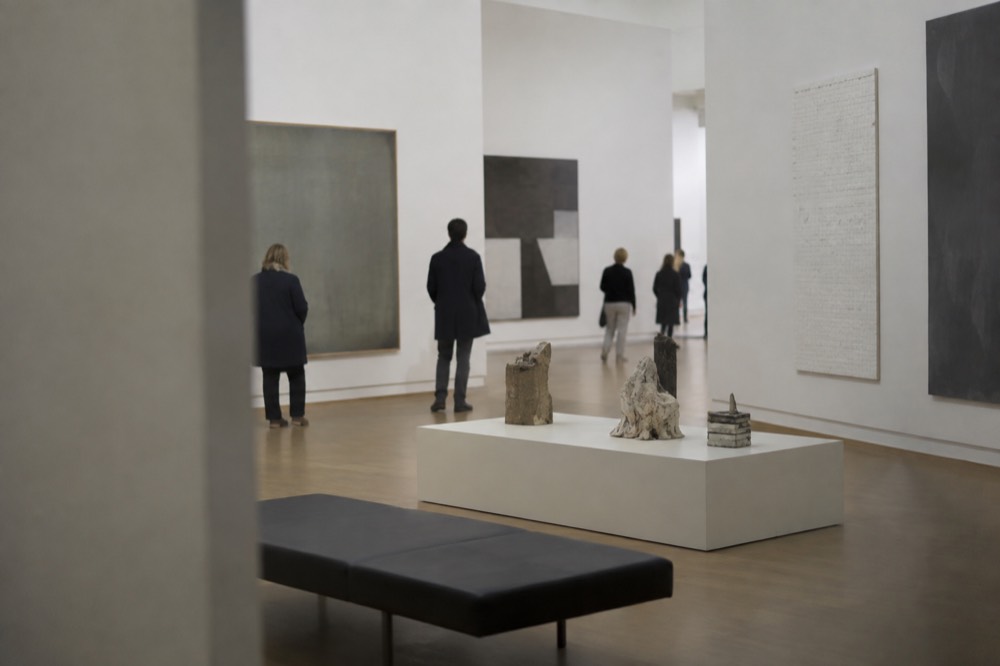
The modern galleries carry the recognisable names of the early twentieth century, and the museum's strength in De Stijl and related movements reflects the collection's Dutch roots. The postwar and contemporary galleries rotate more freely, and the museum's programming in recent years has leaned into digital and immersive work, part of the same wave that has made the Fabrique des Lumières, over in the Westergas park, a popular standalone stop with a 4.7 rating across 9,566 reviews and tickets from $20.
The design wing is the part visitors most often under-plan. It holds applied art and industrial design rather than paintings, and it rewards a slow half hour from anyone who has ever cared about a chair, a poster or a typeface. Families should note the practical contrast with the city's science option: NEMO Science Museum charges a flat €21.50 for everyone aged four and over, with free roof terrace access from the street, while the Stedelijk's offer for children is the collection itself, which suits older children and teenagers far better than toddlers.
| Gallery area | What it covers | Time to allow |
|---|---|---|
| Early modern painting | Late 19th and early 20th century works, including De Stijl | 30-40 minutes |
| Postwar and contemporary | Mid-century abstraction through current installation and digital art | 40-60 minutes |
| Design wing | Furniture, graphic design, ceramics and industrial design | 20-30 minutes |
| Temporary exhibitions | Rotating shows, ticketed separately in some cases | Varies |
Visitors who enjoy the contemporary end of the Stedelijk often pair it with the Moco Museum, a short walk away on the Museumplein's edge, which holds modern and contemporary work including Banksy and carries a 4.3 rating across 11,775 reviews with tickets from $20. The Moco is smaller, faster and more crowd-pleasing; the Stedelik is deeper and quieter. They are complements, not substitutes.
How Do You Get to the Stedelijk Museum?
The Stedelijk sits on the Museumplein, reached by GVB tram and bus to the Museumplein or Van Baerlestraat stops, with a single GVB ticket costing €3.40 for one hour and a 24-hour day pass at €10.00. Contactless payment works on every GVB tram, bus, metro and ferry. The museum is a five-minute walk from the Rijksmuseum and two minutes from the Van Gogh Museum, so on a museum day the transport question answers itself: arrive once, walk between them.
The fare structure is flat and simple. A one-hour GVB ticket is €3.40, a 24-hour pass is €10.00 for adults and €5.00 for children, and multi-day passes step up from there, per the official GVB price page. Contactless bank card and phone tapping, the OVpay system, also works across the network, with a base fare of €1.16 plus a per-kilometre charge. Anyone holding the I amsterdam City Card already has unlimited GVB transport included for the card's duration, though the card excludes airport transfers and regional transport.
| Ticket | Price | Best for |
|---|---|---|
| GVB 1-hour single | €3.40 | One journey with a transfer |
| GVB 24-hour pass | €10.00 adult, €5.00 child | A full day of tram hopping |
| OVpay contactless | €1.16 base plus per km | Occasional trips without buying a pass |
| I amsterdam City Card | €67 for 24 hours | Transport bundled with museum entry |
Cyclists should know the Museumplein is one of the easier destinations in the centre to reach by bike, with racks around the square's edge, and the museum is a straightforward ride from the Vondelpark side. Our cycling in Amsterdam guide covers the rules and rental picture, and our getting around Amsterdam guide covers the network in full.
When Is the Best Time to Visit?
The best time to visit the Stedelijk is a weekday afternoon, when the Museumplein's two timed-entry museums absorb the morning crowds and the Stedelijk's walk-up capacity is at its loosest; avoid weekend middays and the first hour after opening in peak season. The museum's own hours are not verified in our research, so check the official site for the current schedule rather than a third-party summary.
The seasonal picture matters more than the daily one. Amsterdam recorded 23.7 million tourist overnight stays in 2025, and the city's own forecast expects between 23.7 and 25.1 million in 2026, so the quiet months are genuinely quieter and the busy months are genuinely full. Late autumn and the post-Christmas weeks are the softest periods; spring brings the tulip crowds, and the tulip season weeks of mid-March to mid-May put pressure on every museum square stop.
Within any given day, the pattern on the Museumplein is consistent. The Van Gogh Museum's timed slots pull its crowd in waves, the Rijksmuseum fills from opening, and the Stedelijk's own rhythm stays flatter. Mid-afternoon is therefore the slot where the Stedelijk is comparatively calm even when the square is not. Visitors combining all three museums should read our how many days do you need in Amsterdam guide before committing to a single-day triple.
Rain, incidentally, is the Stedelijk's friend. It is one of the best wet-weather stops in the city precisely because it is indoors, long and uncrowded, and our rainy day in Amsterdam itinerary uses it as a backbone stop.
What Should You Know Before You Go?
Before visiting, know three things: the Stedelijk needs roughly two hours, it is the walk-up-friendly museum on the square while its neighbours need timed bookings, and both major passes include it, which makes it the cheapest of the three big Museumplein museums for card holders. A few smaller practical points round that out.
First, book the Van Gogh Museum before anything else. Its own site is explicit that every visitor needs a pre-booked timed ticket, and slots in peak season go first. The Stedelijk can be decided on the day. Second, if you hold or plan to buy a Museumkaart or City Card, do not also buy a Stedelijk ticket, because you would be paying twice for the same door. Third, the Museumplein itself rewards a spare half hour: the lawn, the pond and the sculpture around the square are free, and our Museumplein guide covers what else sits on it, including the Moco Museum and the diamond museum.
For visitors extending the modern-and-contemporary thread beyond the square, the STRAAT Museum on the NDSM Wharf, the world's largest street art museum with more than 180 works by over 170 artists, carries a 4.8 rating across 2,441 reviews with tickets from $24, and pairs well with the free ferry across the IJ. Our Amsterdam Noord and NDSM Wharf guide covers the crossing.
| Question | Short answer |
|---|---|
| Do I need to book ahead? | Not usually; the Van Gogh Museum next door is the one that sells out |
| How long is a visit? | About two hours for the permanent collection |
| Is it on the City Card? | Yes, and on the Museumkaart as well |
| Is it good for kids? | Best for older children and teenagers; NEMO suits younger ones |
| Nearest transport | GVB tram and bus to Museumplein or Van Baerlestraat |
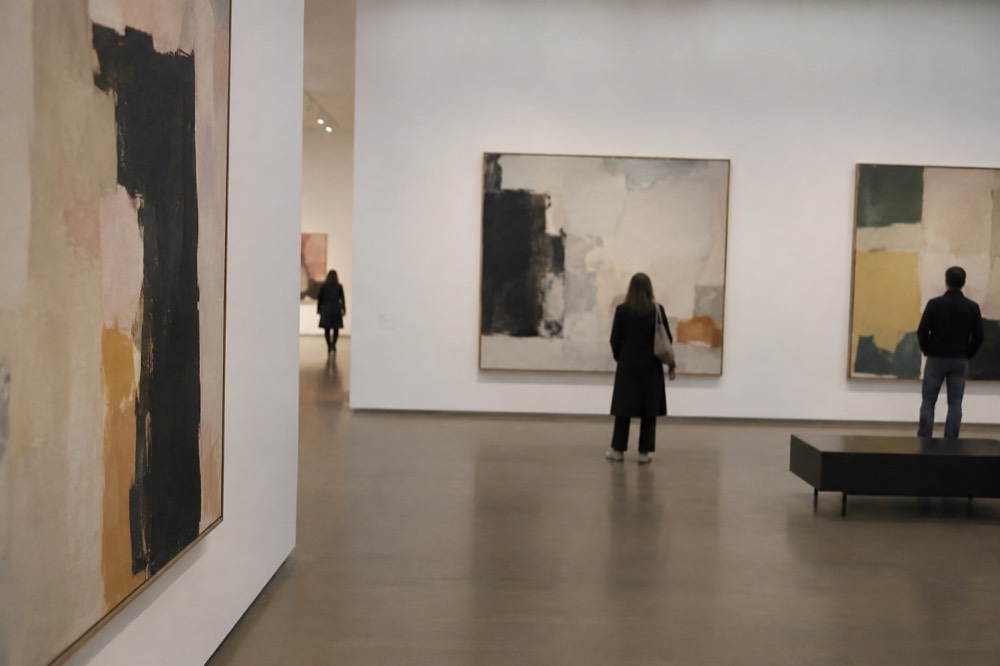
Whichever corner of the square you build your day around, the three bookable options below are the ones most travellers pair with a Stedelijk visit.
Common Questions About the Stedelijk Museum Amsterdam
Is the Stedelijk Museum worth visiting?
For anyone interested in modern art, design or contemporary work, yes. It is the strongest Museumplein choice for visitors less drawn to the Golden Age, it is rated 4.4 across 1,850 reviews, and its two-hour visit length makes it an efficient companion to its two bigger neighbours rather than a competing commitment.
How much do Stedelijk Museum tickets cost?
A skip-the-line entry ticket starts at $26 per person on the live listing. The official walk-up price is not verified in our research, so check the museum's own site. The Museumkaart and the I amsterdam City Card both include entry.
How long should I spend at the Stedelijk Museum?
Plan on about two hours for the permanent collection, which covers the modern galleries, the postwar and contemporary rooms and the design wing. Visitors who add a temporary exhibition can stretch toward the full day the ticket allows.
Is the Stedelijk Museum included in the I amsterdam City Card?
Yes. The card includes entry to more than 70 museums and locations, plus unlimited GVB transport, a canal cruise and a 24-hour bike rental. The Van Gogh Museum and the Anne Frank House are the two notable exclusions.
Should I visit the Stedelijk or the Van Gogh Museum?
Visit both if the day allows: they are two minutes apart. If only one fits, choose the Van Gogh Museum if the artist is the reason for the trip, and the Stedelijk if you want breadth, design, or a museum you can enter without a pre-booked timed slot.
How do I get to the Stedelijk Museum?
Take a GVB tram or bus to the Museumplein or Van Baerlestraat stops. A one-hour GVB ticket is €3.40 and a 24-hour pass is €10.00, and contactless bank cards work on the whole network. The museum is a short walk from both of its Museumplein neighbours.