Currency in Amsterdam: A Guide to Cards, Cash and Maestro Payments
The euro rules the canals, but the way you pay for a stroopwafel or a museum ticket can still trip up first-time visitors. This guide walks you through which cards work, when cash is the only option, and how to avoid the old Maestro trap that catches travellers every year.
Short answer
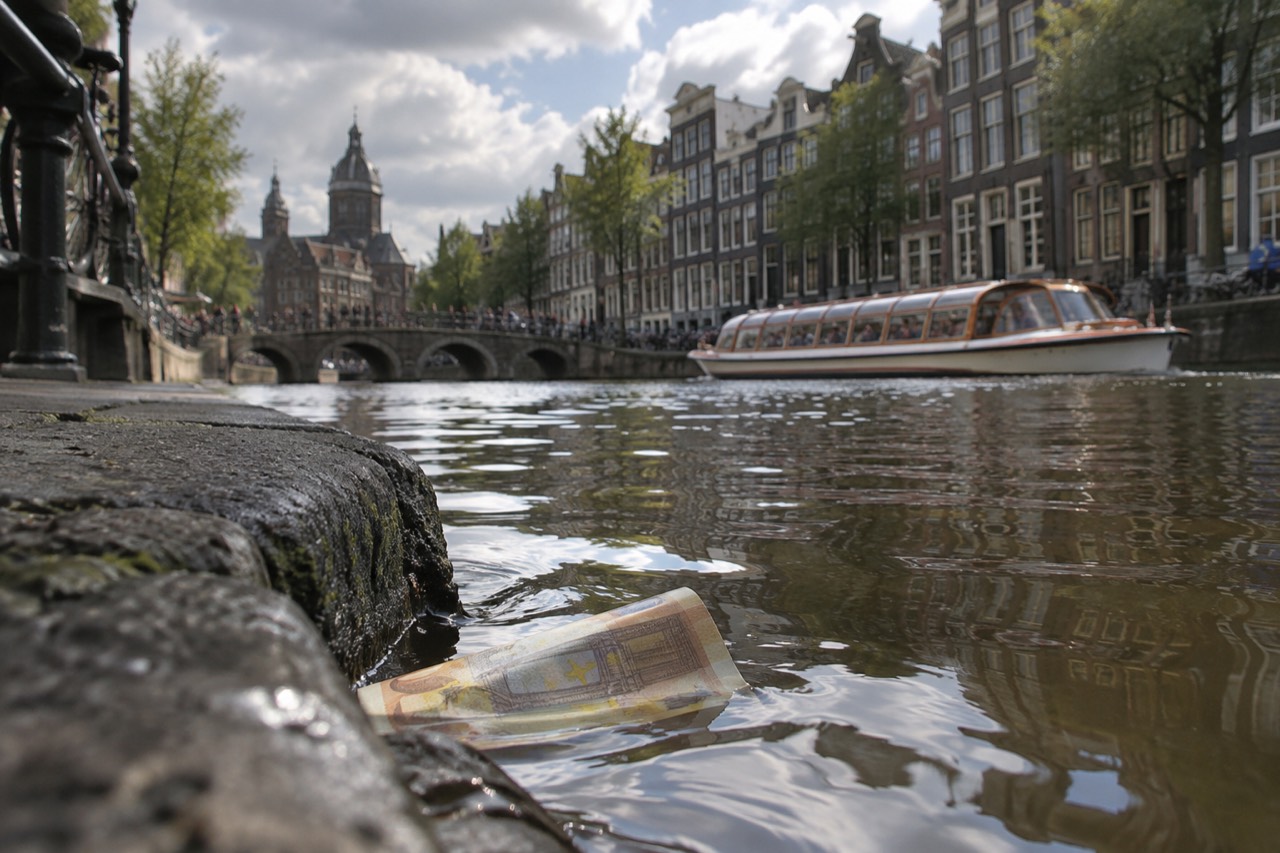
Amsterdam runs on euros, and contactless Visa and Mastercard are now widely accepted in hotels, restaurants, museums and larger shops. You still need a small amount of cash for market stalls, some brown cafés and public toilets, but carrying a fat wallet of notes is no longer necessary: a mix of a low-fee travel card and €50–€100 in cash per day will cover you smoothly.
When the Netherlands swapped guilders for euros, the coins changed but the country's deep preference for pin-only debit cards stayed stubbornly in place for another two decades. Now, slowly, that has shifted: contactless Visa and Mastercard finally work in most places travellers actually visit. You can pay for a rijsttafel in De Pijp, tap your phone on a tram, and pick up a Van Gogh timed-entry ticket online without ever touching a single cent. Yet Amsterdam still has pockets where the card reader gives you nothing but a cold red blink, and understanding why, and exactly how much cash to carry, saves you a lot of awkward moments at a bar counter. The Things to Do in Amsterdam desk has pulled together the straightforward payment picture for a trip this year.
What Currency Do I Need in Amsterdam?
The only legal currency throughout the Netherlands is the euro (€). No other currency is accepted in shops, restaurants, museums or on public transport. Banknotes come in €5, €10, €20, €50, €100, €200 and €500 denominations, though many businesses refuse €100 notes and larger. Coins run from 1c to €2, and small change is handy for market stalls and unattended ticket machines.

The euro is the common currency across all nineteen eurozone countries, so any leftovers from a trip to Paris, Berlin or Rome will work here. You do not need to buy Dutch-specific euros, and exchanging dollars, pounds or other currencies at a bank or bureau de change inside Amsterdam generally gives you a worse rate than simply withdrawing euros from a local ATM. Be aware that many shops, especially outside the tourist centre, will not break a €50 note before noon, and some will politely refuse it altogether if the bill is below €20. Carrying two or three smaller notes and a handful of coins makes the first hour of your day much smoother.
For the cleanest rate, order a small amount of euros from your home bank a week before departure, enough to cover a taxi from Schiphol and a morning coffee, then use ATMs in Amsterdam for the rest. Avoid the multi-currency exchange kiosks inside the airport arrivals hall; their spreads are punishing and the ATMs just past passport control charge standard network rates.
Do Dutch Shops Accept Credit Cards?
Major hotels, department stores, supermarkets and museum desks now accept Visa and Mastercard, both chip-and-PIN and contactless. American Express still only works in high-end hotels, a handful of flagship restaurants and at Schiphol, so never rely on it as your primary plastic. The old Dutch prejudice against credit cards has faded in the city centre, but small independent cafés, street markets and many brown bars remain debit-only or cash-only.
The days of a waiter waving your Visa away with a frown are mostly over, but the real-world rule is uneven. Albert Heijn, the supermarket chain you will see on every other corner, took years to accept credit cards and now does so at nearly all its Amsterdam branches. Jumbo, Dirk and Lidl followed. Still, about one in five inner-city lunchrooms, broodjeszaken and poffertjes stalls still displays a tiny handwritten "alleen pinnen" sign, meaning only Dutch debit cards, or a "cash only" sticker in the window. A contactless Mastercard or Visa issued abroad works like a local debit card on the Dutch payment network, so the "pinnen" sign usually includes your foreign bank card, but it is not an absolute guarantee.
The simplest way to keep life friction-free is to carry two payment methods: a travel-optimised contactless card from the likes of Wise or Revolut for everyday taps, and a backup stash of euro cash for the stalls and family-run shops. If your home card charges a foreign-transaction fee, a prepaid or multi-currency card loaded with euros avoids a 2 to 3 percent surcharge on every cheeseburger and every stroopwafel. For a deeper look at how much a full day in the city actually costs, our trip budget breakdown walks through accommodation, food, transport and attraction spends in detail.
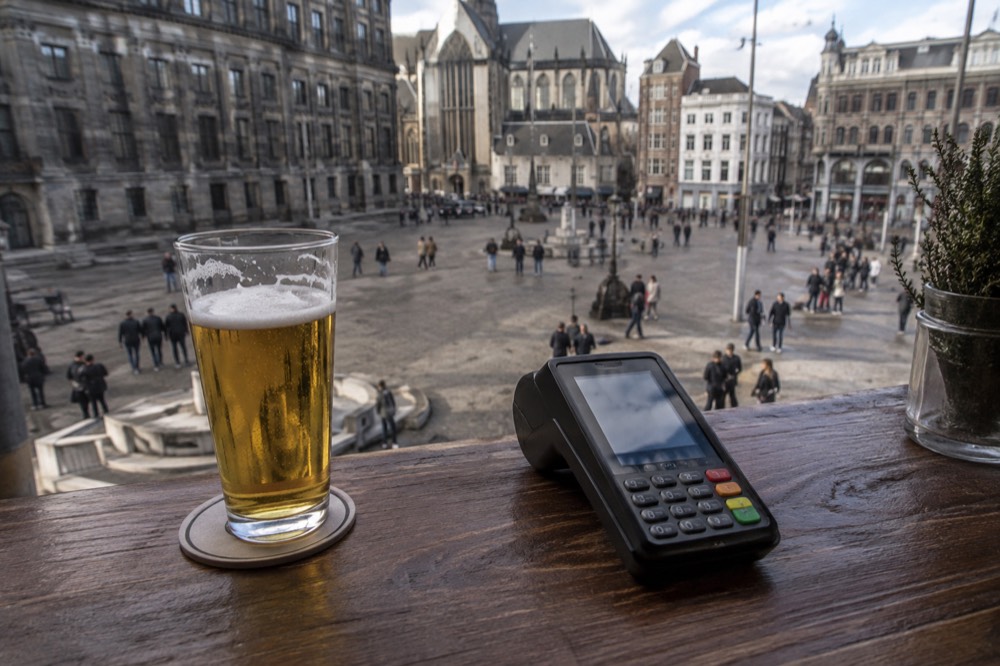
The table below summarises how the most common payment methods perform in different categories of Amsterdam business.
| Where you are | Visa / Mastercard (contactless) | American Express | Dutch bank card (debit) | Cash |
|---|---|---|---|---|
| Major hotels (3-star and above) | Accepted | Often accepted | Accepted | Accepted |
| Large museums (Rijksmuseum, NEMO) | Accepted online and at the counter | Rarely | Accepted | Accepted (ticket counter only) |
| Supermarkets (Albert Heijn, Jumbo, Lidl) | Accepted in most branches | Not accepted | Accepted | Accepted |
| Independent cafés and lunchrooms | Most accept; some are cash-only | Very rarely | Accepted | Always works |
| Street markets (Albert Cuyp, Bloemenmarkt) | Some stalls accept contactless | Never | Some stalls | Preferred method; bring coins |
| Brown bars and old-style pubs | Uneven; often cash or Dutch debit only | Never | Usually accepted | Always works |
If you want to skip queues and lock in a time slot for a top-ticket museum, paying online with an international Visa or Mastercard is the easiest route. The operator's own listing typically lets you reserve now and cancel for free up to 24 hours before your visit.
Is Cash Still Used in Amsterdam?
Cash is far from dead, but you need far less of it than you did even a few years ago. Most visitors get through a day with zero notes and only their contactless card, yet some of the city's most characteristic moments, buying herring from a cart, tipping a street-organ grinder, and using a coin-operated public toilet, all depend entirely on coins and small notes. Carry €50 to €100 per day in cash as a safety net.
The Dutch national bank confirms that cash still accounts for roughly one in five point-of-sale transactions nationwide. In Amsterdam's tourist district that figure is lower, but in the Jordaan, the Plantagebuurt and the outer canal belt many smaller businesses still run on notes and coins. Weekend street markets are a particularly cash-heavy environment: cheese, flower and fish vendors often have no card terminal at all. Even when they do, a tiny minimum spend, commonly €5 or €10, means buying a single ball of fresh mozzarella is a coin-only exercise.
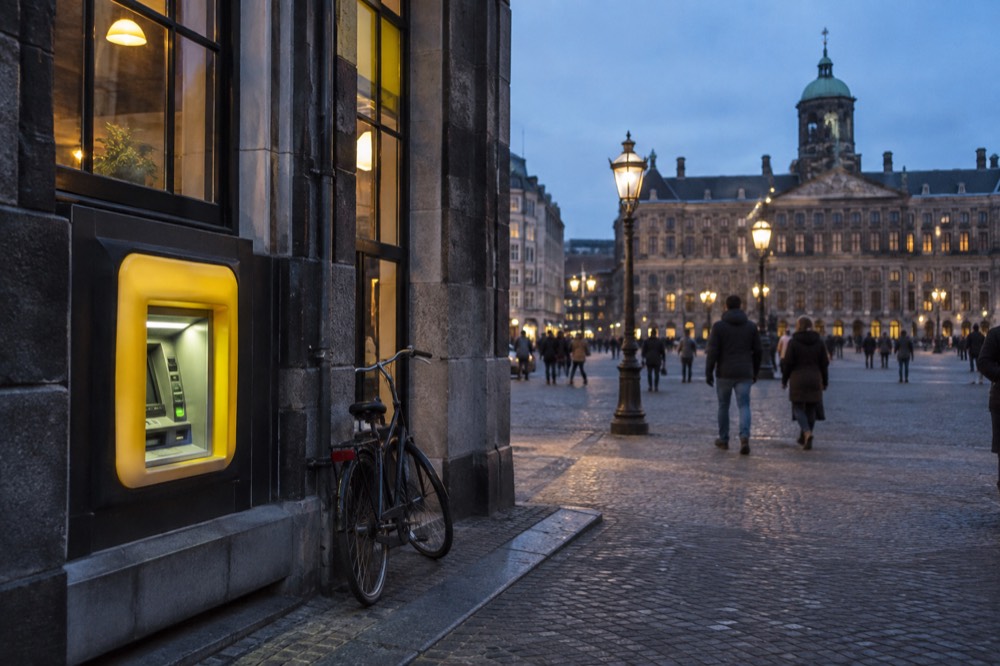
ATMs, known locally as "pin-automaten" or by the yellow "Geldmaat" branding, are plentiful in the centre. Geldmaat machines accept foreign Visa, Mastercard and Maestro cards and typically offer a screen in English. Choose "withdrawal without conversion" when prompted, as this applies your home bank's wholesale exchange rate instead of the ATM's own inflated one. Avoid the blue-and-yellow Euronet ATMs tucked inside souvenir shops or next to coffeeshops; their fees and poor exchange rates can chew through a large slice of your withdrawal before you even touch the street. If you are travelling on a tighter budget, our Amsterdam on a budget guide lays out which meals, museums and transport passes give you the most value for each euro.
What About Maestro and V-Pay?
For years, the Dutch payment network relied almost entirely on Maestro and V-Pay, two debit-card brands that were standard on every local bank card but unfamiliar to most travellers. That meant a UK-issued contactless Visa would fail in Albert Heijn or at a train-ticket machine. The situation has now flipped: Mastercard and Visa have replaced Maestro and V-Pay on all newly issued Dutch bank cards, and the old warnings are out of date.
The transition began in earnest when the banks decided to retire the Maestro and V-Pay co-brands and issue all new debit cards under the Mastercard Debit and Visa Debit banners. By September 2026, the overwhelming majority of Dutch current-account holders already carry a Mastercard or Visa debit card, and the few remaining Maestro cards will be gone soon. For international visitors, this means the old Maestro-only stigma is fading fast: your home Visa or Mastercard is not seen as a "credit card" and treated suspiciously; it simply slides into the same payment terminal as the Dutch one.
The real-world gain is most visible at supermarket checkouts, where the wall-mounted stickers once read "Pinnen yes, credit card no" and the cashier would direct you to the lone ATM. Today, the same sticker says "Pinnen & contactloos" and your phone or foreign card works. A handful of unattended ticket kiosks, at a few small railway halts and parking garages, still ask for Maestro, but the patches are disappearing each month. If you want to see how a museum ticket purchase works in practice, the Van Gogh Museum guide explains the timed-entry booking flow step by step.
Even so, it is wise to carry a card that has both contactless and chip-and-PIN capability, because Dutch terminals still occasionally demand the PIN rather than a signature. If your home bank only sends you a signature-based card, ask for a PIN-enabled version before you travel, or carry a backup prepaid card that you can load with euros.
| Payment method and period | Dutch-issued Maestro / V-Pay | Dutch-issued Mastercard / Visa Debit | Foreign contactless Visa / Mastercard at major retailers | Foreign Visa / Mastercard at small Amsterdam shops |
|---|---|---|---|---|
| A few years ago | Almost all local cards | Rare | Only large chains accepted | Very few accepted |
| Last year | Roughly 40% of cards | Roughly 60% | About 70% acceptance | About 55% acceptance |
| 2026 (year-end projection) | Almost none | Nearly all local cards | Over 90% acceptance | About 80% acceptance |
Should I Get Euros Before I Arrive?
Buying a small float of euros before you leave home is a sensible piece of peace-of-mind planning. It means you can pay for the train from Schiphol, grab a snack and tip a porter without searching for an ATM at the terminal. About €100 in mixed notes, one €50, two €20s and a tenner, is plenty. Do not buy large amounts from an airport bureau de change.
Your own high-street bank can order euros from its foreign-currency desk, often for next-day collection if you order a week ahead. The rate will be a modest margin off the mid-market, which is far better than the steep mark-up that the Travelex-style counters in airport departure lounges apply. Some online-only services, such as Wise or Revolut, let you convert at the interbank rate for a small fee and then spend the euros directly from a linked debit card, which completely removes the need to carry large cash sums. If you arrive without a single euro, take a deep breath and walk past the first currency kiosks you see inside Schiphol's baggage hall; the Geldmaat ATMs thirty metres further along offer a far better rate and are easily identified by their bright yellow signage.
How Much Cash Should I Carry per Day?
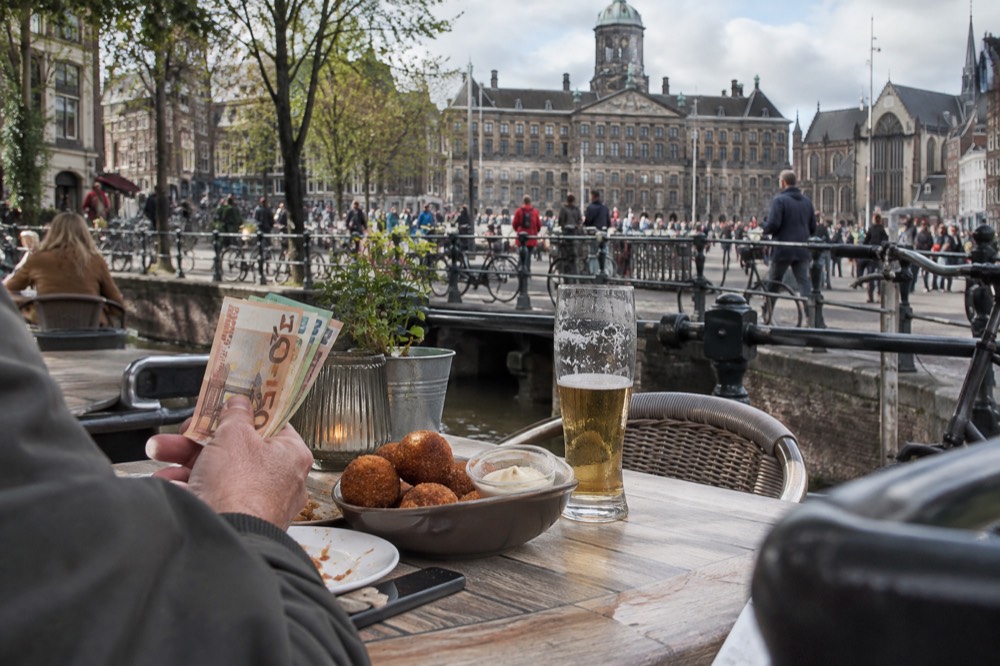
A comfortable daily cash cushion for two people is about €80 to €100, split into a mix of notes and coins. This covers small-plate snacks, market purchases, a couple of drinks in cash-only bars, and coin-fed facilities. If you plan to eat only in full-service restaurants and pay for every museum ticket online, you can drop that to €30 to €40.
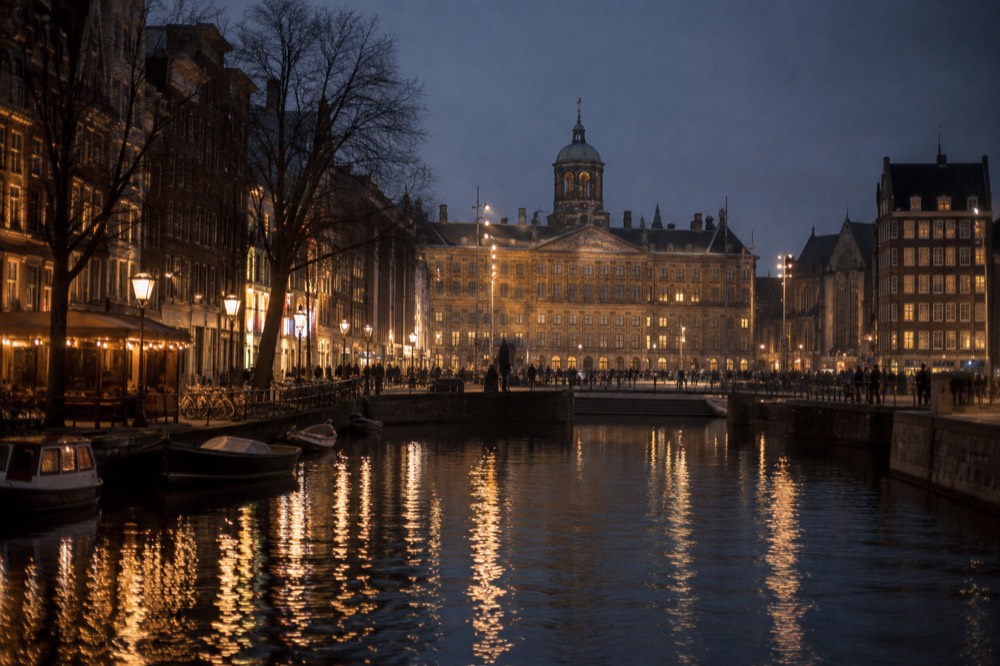
Crime against tourists in Amsterdam is overwhelmingly opportunistic pickpocketing in crowded areas such as the Red Light District and the Damrak tram stops. Spread your cash across two or three different places, a money belt, a zip-pocket in your daypack, and a small wallet for daily taps, so that losing one is not a crisis. Never keep all your notes in a back pocket or a loose, open handbag. The hotel safe should hold the bulk of your backup money and a spare card.
A simple breakdown for a couple on a typical day looks like this: €20 for the morning market and a coffee, €30 for lunch in a sit-down café that might only take Dutch debit or cash, €20 for the afternoon waffle and coin-laundry visit, and €30 as a just-in-case fund for the evening bar hop. On a museum-heavy day, you will need less cash because lunch in the museum café and the entry ticket can both go on a card. If you are wondering whether €100 a day is enough, our breakdown answers that question with real prices from the current season.
Tipping and Service Charges in Amsterdam
Tipping is not an obligation in Amsterdam, but rounding up to the nearest €5 or €10 on a restaurant bill, or leaving about 5 to 10 percent for notably good service, is the local custom. Service is often already included in the menu price, so if you see "service included" or "inclusief" on the bill, there is genuinely no expectation of extra cash. Bar staff and taxi drivers are given the "keep the change" treatment.
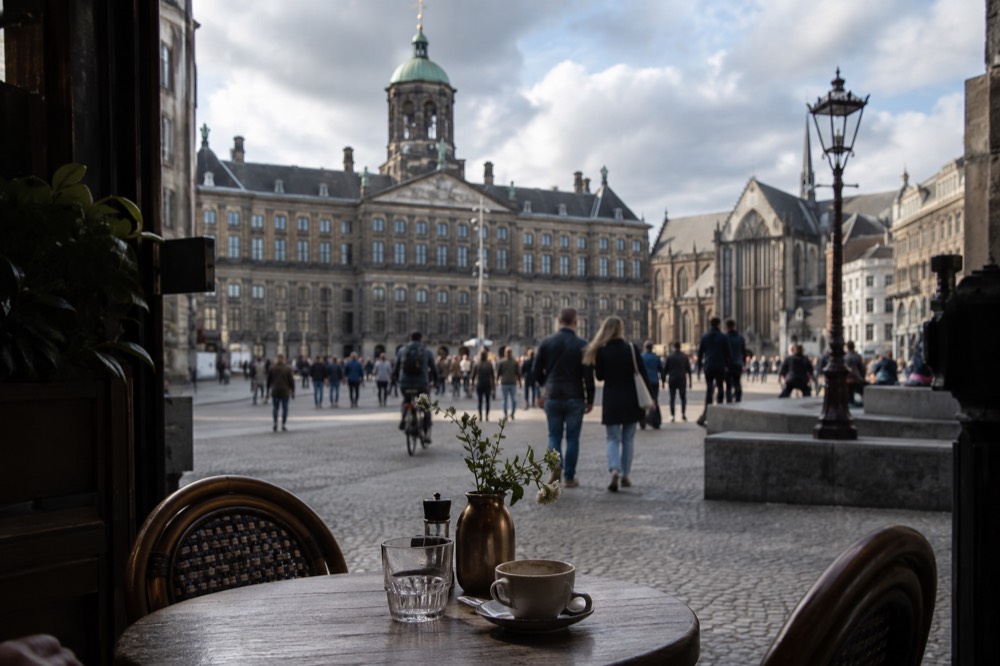
The Dutch approach to hospitality is that a fair wage is built into the price of the meal, and the server does not depend on tips to make a living. Still, a tip is appreciated as a gesture, never demanded. If a credit-card terminal offers you the option to add a tip, you can either tap the amount you feel is right or skip the screen entirely; nobody will chase you down the street. When paying in cash, simply hand over a note, say "Laat maar zitten" ("keep the change") and you have nailed the local code.
For group tours, free walking tours and canal cruises, a tip is genuinely welcome because guides often rely on them. For a free GuruWalk tour, the custom is to tip €10 to €20 per person, depending on how much you enjoyed it. For a pre-paid small-group canal cruise, an extra €5 for the skipper is a kind way to say thank you.
| Situation | Typical local gesture | Whether it is expected |
|---|---|---|
| Restaurant (service already included) | Round up bill to nearest €5 or €10 | No |
| Restaurant (service not listed) | 5 to 10% of the pre-tax total | Soft yes, especially for good service |
| Café / brown bar | "Keep the change" on a round | No |
| Taxi | Round up to nearest euro | No |
| Free walking tour | €10 to €20 per person | Yes, this is the guide's income |
| Canal cruise (skippered) | €3 to €5 if you enjoyed the commentary | Not expected, appreciated |
Contactless, Mobile Wallets and the Apple Pay Reality
Contactless payments are the default in Amsterdam. Every payment terminal that takes a card also accepts an Apple Pay, Google Pay or Samsung Pay tap, and the old €50 limit that once existed in some countries disappeared here long ago. Tapping your phone or watch is now so common that a cashier will look surprised if you pull out a plastic card instead. Locals pay for expensive rounds of drinks with a single tap of their phone.
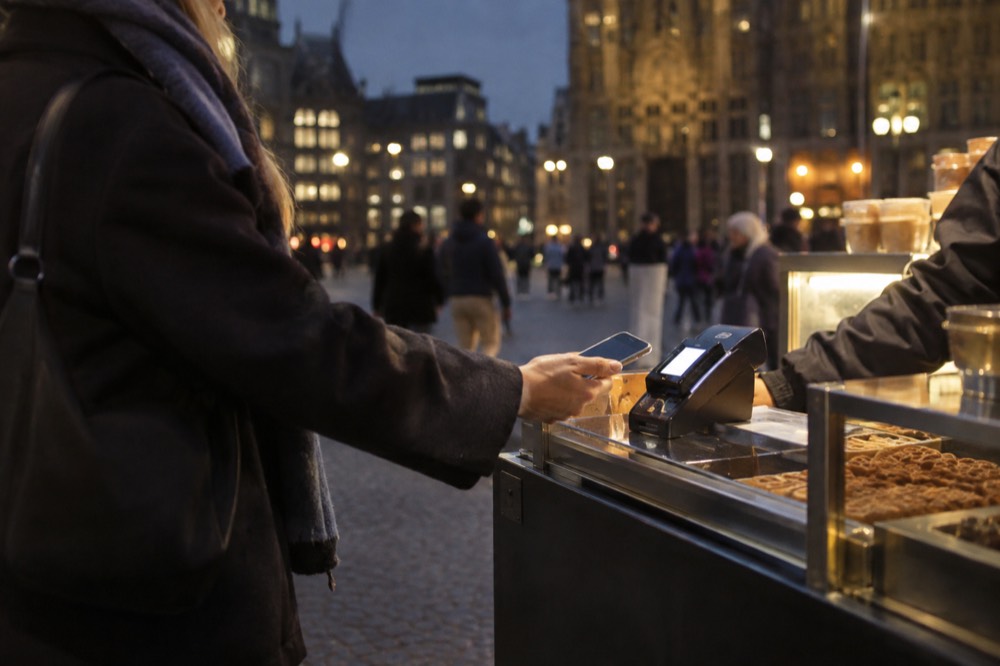
Apple Pay and Google Pay piggyback on the same Visa and Mastercard networks, so anywhere that accepts one of those card brands will also accept your mobile wallet. The only small exception is some unmanned petrol-station pumps and older parking-garage ticket machines that still demand a physical chip-and-PIN insertion. In central Amsterdam, you will likely never encounter one, but if you plan to drive into the countryside, keep a plastic card handy.
If you are using a prepaid travel money card, check that it supports mobile wallet registration; most of the new-generation multi-currency accounts from Wise, Revolut and Monzo do so instantly. For US travellers with a Chase Sapphire or Capital One card, the tap-to-pay works identically to at home, with no foreign-transaction fee if your card waives them.
A handful of smart-bite-sized spots, like the self-service lockers in Central Station and the Museumplein bike rental kiosks, still ask for a physical card with a PIN, so do not leave home without at least one plastic rectangle in your bag alongside your phone.
Traveller's Cheques Are Dead, and Prepaid Maestro Cards Are No Longer Necessary
Traveller's cheques belong to a bygone era and no Amsterdam bank, hotel or bureau de change will cash them. The tourist-focused prepaid Maestro cards that were once sold at Schiphol have also disappeared. With the universalisation of Mastercard and Visa debit on the domestic payment network, there is no reason to pay an upfront issuance fee for a disposable card that will be obsolete before your next trip.

A multi-currency app with a linked debit card gives you exactly the same local-debit acceptance, a better exchange rate and zero chip-and-PIN friction. The days of carrying a separate plastic rectangle just for the Netherlands are over. For more on avoiding unnecessary travel costs, our City Card value guide runs the numbers on whether a pass really saves you money versus paying as you go.
How to Get the Best Exchange Rate While You Are in Amsterdam
The golden rule is simple: never let a merchant, an ATM or a restaurant terminal convert your bill into your home currency. When the screen offers "pay in euros" versus "pay in your own currency," always choose euros. This practice, known as Dynamic Currency Conversion, pads the exchange rate with an extra 3 to 8 percent marketing margin that entirely benefits the local bank. The same logic applies at every ATM.
If you are travelling from the United States, a no-foreign-transaction-fee credit card gives you the Mastercard or Visa mid-rate with no surcharge, so you literally get the same rate as a large currency-transfer firm. From the UK, the Chase, Wise or Monzo debit cards are popular for the same reason. From Canada, the Wise card or a no-FX-fee card with a modest network markup will keep costs low. Wherever you come from, a dedicated travel card loaded with euros before departure eliminates the surprise of poor airport rates.
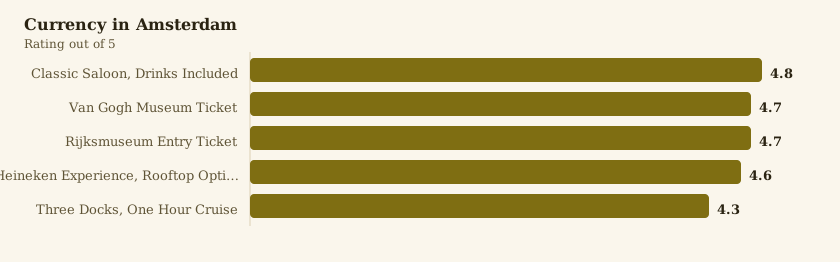
As a final money-saving observation, the same principle applies to a website you probably already know: booking museum tickets online rather than queuing at the counter earns you a better slot, and you can cancel at no cost if your plans change. The Van Gogh Museum ticket on the live listing is a perfect example, you lock in the exact hour you want, pay in euros, and avoid the midday sell-outs.
Common Questions About Currency in Amsterdam
Can I use US dollars in Amsterdam?
No. US dollars are not accepted anywhere except at a bureau de change, and even there the rate will be poor. Bring euros or withdraw them from a local ATM after you arrive.
Is it better to bring cash or use a card in Amsterdam?
A mix is ideal. Use a contactless Visa or Mastercard for most purchases, but carry €50 to €100 in cash for markets, small cafés and coin-operated facilities. Cards now work in far more places than they did even two years ago.
Do I still need a Maestro card for the Netherlands?
No. The old Maestro-only network has been replaced by Mastercard and Visa debit cards issued by Dutch banks. Your foreign contactless card now works in the vast majority of shops, supermarkets and restaurants.
Are ATMs free in Amsterdam?
Geldmaat ATMs do not charge a fee to the user, but your home bank may apply its own foreign-withdrawal charge and a currency-conversion markup. Check with your bank before travel, and always choose "without conversion" on the ATM screen.
How much should I tip in Amsterdam?
Tipping is not required, but rounding up a restaurant bill by 5 to 10 percent or leaving the change is the local custom. In bars, "keep the change" is the norm. For free walking tours, €10 to €20 per person is expected.
Will my American Express card work in Amsterdam?
Only in upscale hotels, a few fine-dining restaurants and at Schiphol Airport. Do not rely on American Express as your main payment method; carry a Visa or Mastercard instead.