What Is A Must Buy In Amsterdam?
The souvenirs actually worth carrying home from Amsterdam, from tulip bulbs and aged cheese to Delftware and museum-shop finds, with where to buy each one.
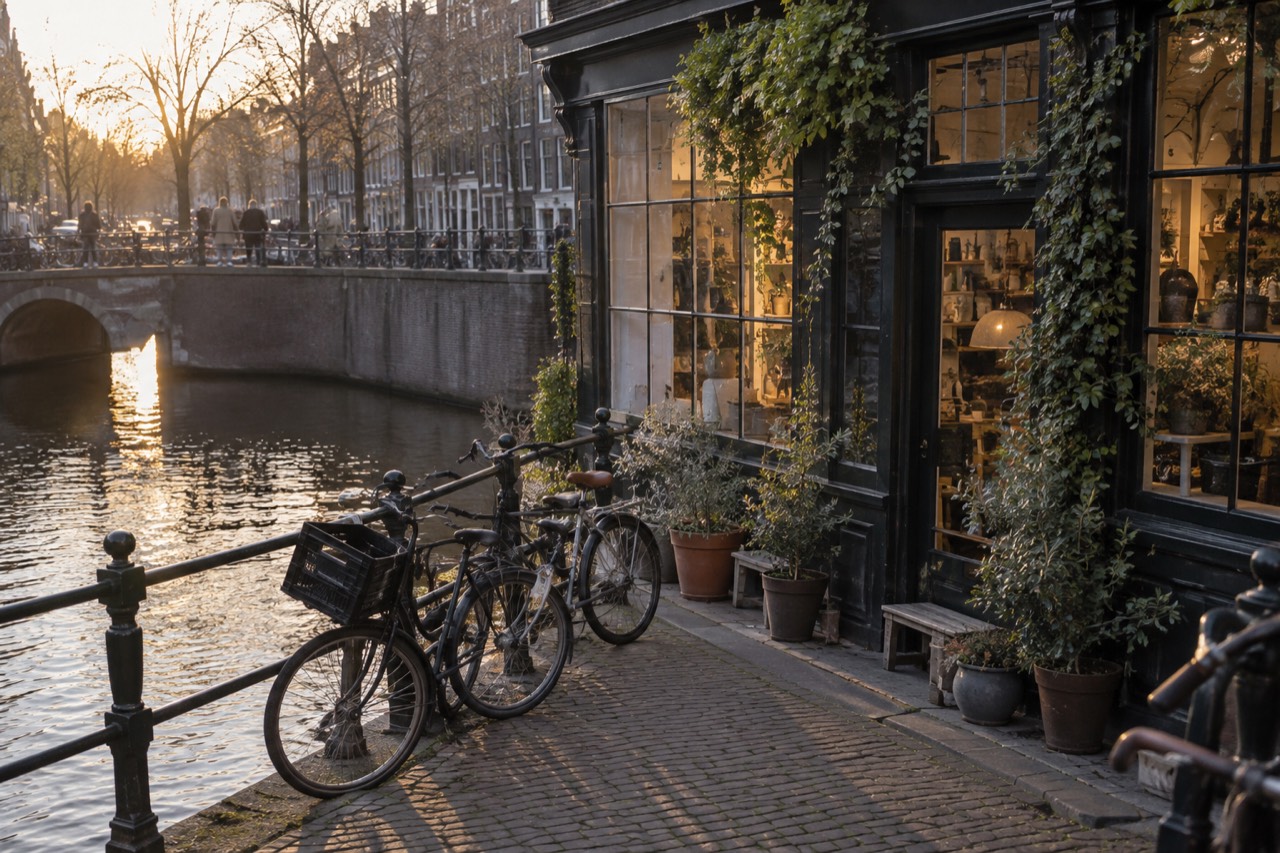
Amsterdam's souvenir economy is enormous, and most of it is landfill. Walk from Dam Square to the station and you will pass racks of plastic clogs, shot glasses, novelty aprons and "funny" T-shirts, all of it imported and none of it Dutch. The city recorded 23.7 million tourist overnight stays in 2025, and a market that size attracts sellers who price for people who will never come back. The good news is that the real stuff sits within ten minutes of the fake stuff, often on the same street, and it costs only slightly more. This page is the short list: the things worth buying, the neighbourhoods to buy them in, and the purchases that only look like bargains.
What Is A Must Buy In Amsterdam?
The five buys that consistently justify their luggage space are tulip bulbs from a licensed grower, wheel-aged Gouda from a cheese shop, Delftware or modern Dutch ceramics, genever or a bottle from a small distillery, and one considered piece from a museum shop. Each is made in the Netherlands, survives the journey home, and carries a story you can still tell a year later. None of it needs to be expensive. A bag of bulbs and a wedge of cheese can cost less than the plastic clogs, and they are the souvenirs people actually ask about.
Start with the honest framing: Amsterdam is not a bargain city, and it has not been for years. The municipal tourist tax alone sits at 12.5 percent of the overnight price at hotels and holiday rentals, and that pressure shows up in every shop near Damrak. The way to buy well here is not to hunt discounts in the centre but to buy specific things from specific kinds of sellers: growers, cheese specialists, working studios and museum shops. The mass-market stalls, by contrast, exist to move volume.
There is also a time dimension most visitors miss. The best food souvenirs are seasonal, the best ceramics are limited runs, and the museum shops rotate their stock with every exhibition. A Saturday afternoon in the Nine Streets or the Jordaan will beat an hour at a souvenir stall every single time, and the price difference is smaller than the quality gap. If you only have a few hours of shopping in the city, spend them on the list below rather than browsing.
For anyone planning a museum-heavy trip alongside the shopping, the practical purchases and the sightseeing overlap: the biggest museums here run shops that are destinations in their own right, and a ticketed visit is often the easiest way to reach the best merchandise.
Are Tulip Bulbs A Good Souvenir To Bring Home?
Yes, tulip bulbs are the classic Amsterdam buy and still one of the best, provided you purchase certified bulbs with the paperwork that allows them through customs, and provided you buy them in autumn or early spring rather than expecting them year round. Bulbs are a live agricultural product. The ones sold in proper packaging, marked with a health certificate and a customs-friendly label, are legal to take home to most countries including the United States. Loose bulbs from a market bucket, with no documentation, are exactly what border inspections are designed to catch.
The Bloemenmarkt, the floating flower market on the Singel, is the famous place to buy, and it is a genuine Amsterdam institution even in its current tourist-heavy form. The stallholders there sell bulbs in sealed, certified packs, and the packaging states plainly which countries they can be posted or carried to. The mistake visitors make is buying in April and expecting the same stock in July: the bulb trade runs on the Dutch growing calendar, and the choice is widest from September through the spring season. Out of season, the market sells dried bulbs that may or may not flower, and that is the gamble.
If you want the deeper version, the bulb fields around Lisse and the wider Bollenstreek are a day trip away, and buying at the source means buying from growers rather than resellers. Our guide to the tulip fields at Lisse covers the season and the transport, and our piece answering whether you can bring tulip bulbs back to the US goes through the customs rules in detail. Read that one before you buy, because the rules are specific about packaging, quantity and certification, and they change.
One honest note on timing: Keukenhof, the great spring garden that anchors the whole tulip economy, opens only from mid-March to early May, with the 2027 season running 18 March to 9 May. A spring trip buys you flowers in the ground and the full bulb market at its peak. An autumn trip buys you the planting stock itself, which is arguably the more useful souvenir, since you take home next spring's display rather than a photo of someone else's.
Where Should You Buy Cheese, Stroopwafels and Other Food Gifts?
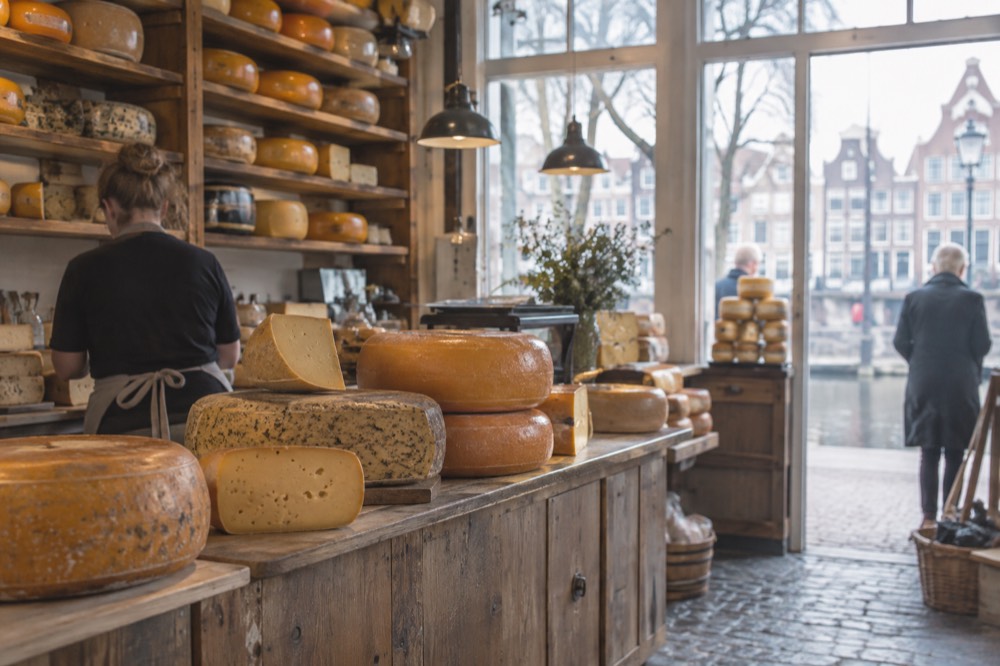
Buy cheese from a specialist cheese shop that vacuum-seals it for travel, buy stroopwafels from a bakery rather than a supermarket, and treat everything else as a bonus: the food souvenirs are the ones with the shortest shelf life and the highest payoff. The Netherlands exports cheese on an industrial scale, and the difference between a wedge cut from a wheel aged 12 months or more and the plastic-wrapped blocks at the airport is the difference between a souvenir and a snack. The shops in the centre, around the Bloemenmarkt and in De Pijp, will cut, taste and seal everything for you.
Cheese shops here operate like wine shops. You taste before you buy, the staff will tell you how long each wheel was aged, and vacuum sealing is standard and usually free, which solves the luggage problem entirely. Aged Gouda travels for weeks in a sealed pack and improves the story you tell with it. The same shops sell the accessories, the little wooden knives and the mustard, but the cheese itself is the purchase. Ask for the aged wheels specifically, because the young cheese is what the export market is flooded with.
Stroopwafels belong to the bakeries, and the freshest ones come off the iron at markets like the Albert Cuyp Market, where they are made in front of you and eaten warm. A pack of factory stroopwafels is still a decent gift, but the market version is the reason the factory version exists. Other food buys worth the space: Dutch chocolate letters if you are travelling near the Sinterklaas season, speculaas spices, hagelslag for the breakfast-sprinkle experience, and salted liquorice if you want to give someone a genuine cultural challenge.
| Food souvenir | Best place to buy | Shelf life and travel notes |
|---|---|---|
| Aged Gouda or other wheel cheese | Specialist cheese shops, centre and De Pijp | Weeks once vacuum-sealed; ask the shop to seal it |
| Fresh stroopwafels | Albert Cuyp Market and other bakery stalls | Best eaten same day; factory packs travel for months |
| Chocolate letters | Any proper chocolatier, from autumn onward | Seasonal item tied to the Sinterklaas tradition |
| Salted liquorice (zoute drop) | Sweet shops and supermarkets | Travels indefinitely; genuinely divisive gift |
| Speculaas and spice mixes | Bakeries and food halls such as Foodhallen | Dry goods, no sealing needed |
The beer-and-spirits aisle is the other food category worth taking seriously. Heineken is the global name, and the Heineken Experience, the attraction built inside the original brewery, runs a shop stocked with items you cannot find in an airport, alongside a 90-minute visit that 39,581 reviewers have rated 4.6 on the live listing at $23 from. Genever, the Dutch ancestor of gin, is the more interesting bottle: the old distilleries and liquor shops in the centre sell it in traditional stone bottles, and it is a genuinely historic product rather than a brand. Check your home country's duty-free allowance before you commit to more than one bottle.
Is Delftware Worth The Price In Amsterdam?
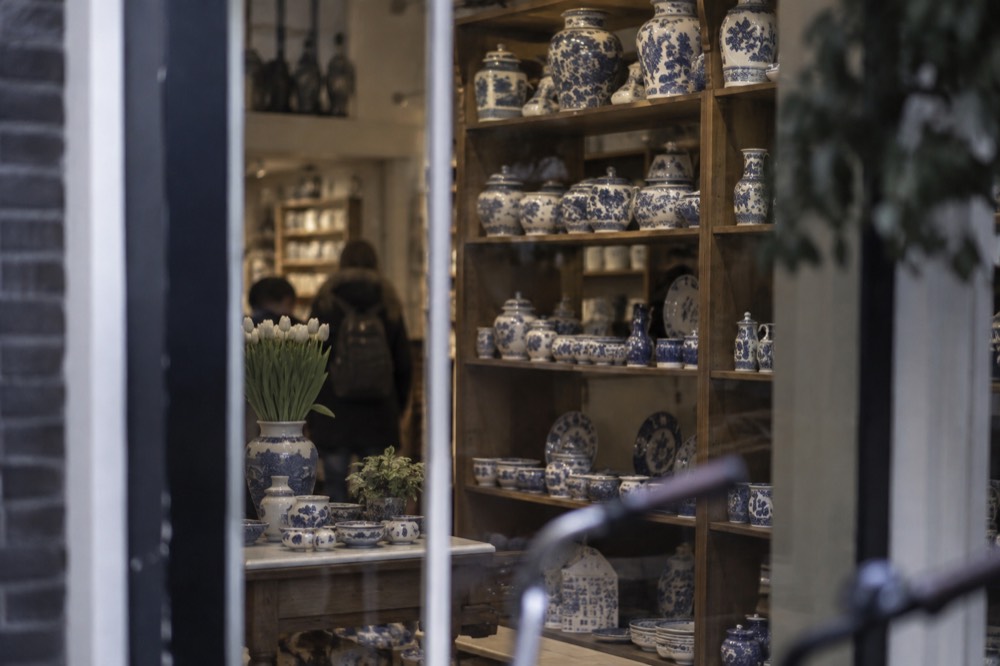
Genuine Delftware is worth buying because it is one of the few souvenirs that is still made by hand in the Netherlands, but the price gap between real hand-painted pieces and the printed tourist copies is enormous, so buy from the factory, a studio or a reputable shop and know which one you are holding. Blue-and-white ceramics are the visual shorthand for the whole country, and Amsterdam sells every tier of it, from pieces painted by an artisan to identical-looking pieces that were printed in a factory on another continent.
The tell is on the base. Real Delftware carries a maker's mark and, for the protected term, a certificate identifying the workshop, and the painting shows slight irregularity because a human hand made it. Hand-painted pieces are expensive, sometimes startlingly so, and that is the honest price of a craft that takes years to learn. Printed copies are cheap, look fine from two metres and are perfectly acceptable as a fun purchase, as long as you pay a fun price and not a craft price. The shops that sell both will say which is which if you ask directly.
Amsterdam also has a strong contemporary ceramics and design scene, and if the traditional blue does not suit your home, the studios of the Jordaan and the design shops of the Nine Streets sell modern Dutch work at prices that undercut antique Delft by a wide margin. Our guide to the Nine Streets shopping quarter maps the independent shops worth the detour, and the Jordaan walk in our neighbourhood guide to the Jordaan passes several studios. A contemporary piece bought from the person who made it is, in the long run, a better souvenir than a printed copy of something old.
| Ceramic tier | What it is | How to check it |
|---|---|---|
| Hand-painted Delftware | Individually painted by an artisan, with a maker's mark | Certificate and mark on the base; slight irregularity in the lines |
| Studio-made modern ceramics | Contemporary Dutch design, often from Jordaan or Noord studios | Buy direct from the maker where possible |
| Printed tourist copies | Decal-printed blue-and-white, made for the souvenir trade | Perfectly uniform pattern, no certificate, low price |
What Should You Buy At Amsterdam's Museum Shops?
The museum shops are the most underrated shopping in the city: the Rijksmuseum and Van Gogh Museum shops sell exhibition-linked prints, books, textiles and design items that are tied to the actual collections, and the stock rotates with every show, so a ticketed visit doubles as the best-curated shopping trip you will take. These are not generic gift shops. The merchandise is commissioned around what hangs upstairs, which means the prints, the jewellery and the homeware have a specific provenance that no souvenir stall can fake.
The Van Gogh Museum shop is the strongest single example. It sells reproductions and design pieces built around the paintings in the building, from Sunflowers prints to sketchbooks and scarf patterns drawn from the letters. The museum itself requires every visitor to pre-book a timed entry ticket, as its own visit pages state, and tickets sell out, so the shop visit is best planned as part of a booked slot rather than an impulse. The entry ticket on our roster is $31 from, with a 4.7 rating across 57,096 reviews on the live listing.
The Rijksmuseum shop works the same way, with a design store that punches well above typical museum retail, and the museum's own pages confirm adult entry is €25 with free admission for ages 18 and under and for holders of the I amsterdam City Card, so a cardholder's museum-shop budget goes further. Our Rijksmuseum visitor guide covers planning the visit itself. Beyond the two giants, the smaller museums run the quirkier shops: the photography museum, the maritime museum and the street art museum STRAAT each sell work you genuinely cannot find elsewhere in the city.
The practical point for shoppers: museum shops are the one place in Amsterdam where the price is honest, the product is specific and the queue is short. If you have limited time, one museum visit with a proper shop session beats an afternoon of souvenir-stall browsing on every measure except speed.
Where Do Locals Shop For Vintage and Design?
Locals shop the vintage stores, record shops and independent boutiques of the Nine Streets, De Pijp and Amsterdam Noord, where the city's actual design culture lives, and those purchases are the ones that still feel like Amsterdam ten years later. The centre sells the postcard version of the city. The neighbourhoods sell the version the residents actually inhabit, and the price difference is often zero, because the same designers sell through both channels.
De Pijp is the everyday version: a dense residential neighbourhood around the Albert Cuyp Market where independent shops sell clothing, homeware and second-hand records between the cafés. The market itself, Europe's largest daytime market by most counts, is a genuine working market rather than a tourist installation, and our guide to De Pijp and our Amsterdam markets guide cover the stall days and the surrounding streets. Vintage clothing is the strongest category here, with several long-established second-hand shops a few blocks off the market.
Amsterdam Noord, across the IJ behind Centraal Station, is the design and studio district. The NDSM wharf hosts makers, vintage kilo sales and studio shops in converted industrial sheds, and the free ferry from the station makes it a 15-minute trip that feels like a different city. Our guide to Amsterdam Noord and the NDSM wharf covers the ferries and what is where. If your souvenir budget is small and your taste is specific, one piece from a Noord studio is the best value purchase on this list.
What Souvenirs Should You Skip In Amsterdam?
Skip the plastic clogs, the novelty T-shirts, the "I Amsterdam" knock-off merchandise, the fake Delft sold at craft prices, and anything sold within sight of a cruise terminal or the Damrak strip, because the city's own visitor rules and shop policy exist precisely because this trade got out of hand. Amsterdam has a formal ban on new tourist-oriented shops in the centre, and the municipal government has kept it in force, which tells you exactly how the residents feel about the souvenir economy. The stalls by the station are the far end of that spectrum.
The plastic clog deserves its own paragraph, because it is the single most-bought and least-useful object in the city. Real wooden clogs exist, are made in the Netherlands and are a legitimate, if bulky, purchase. The hollow plastic version is not Dutch in any meaningful sense, breaks in transit and was moulded for the export market. If you want the clog story, buy the small painted wooden pair or, better, the miniature Delft-style version from a shop that also sells the full-size ones.
The same logic applies to the tulip merchandise: a printed plastic tulip is the opposite of the actual souvenir, which is a bulb that flowers in your garden next April. And the "coffee shop" T-shirts and novelty items are best left alone entirely, both because they age badly and because the city's own visitor guidance asks tourists to treat the coffeeshop culture with more respect than a stag-party T-shirt implies. The municipal "How to Amsterdam" guidance, published by the city itself, is blunt about the behaviours that have worn out the welcome, and shopping like you are at a theme park is one of them.
Common Questions About Souvenirs in Amsterdam
What Is A Must Buy In Amsterdam?
Tulip bulbs with proper certification, wheel-aged Gouda vacuum-sealed for travel, hand-painted Delftware or a piece from a contemporary studio, genever in a traditional bottle, and one considered item from a museum shop. Those five categories cover everything that is genuinely made here, survives the journey and keeps its meaning.
Can I bring tulip bulbs back to my home country?
Usually yes, if the bulbs are certified and sealed. The United States allows bulbs with the right phytosanitary paperwork, which the reputable sellers at the Bloemenmarkt and around Lisse provide in the pack. Loose, undocumented bulbs are the ones that get confiscated.
Is Delftware from Amsterdam real Delftware?
Some of it is. Hand-painted pieces from the recognised workshops carry a mark and a certificate, and those are the real thing. Much of what is sold near the main sights is decal-printed copy, which is fine as a cheap keepsake but should never be bought at a hand-painted price.
How much cheese can I carry home from Amsterdam?
There is no Dutch limit on buying cheese, but your destination country's customs rules decide what crosses the border, and vacuum-sealed hard cheese travels far better than anything fresh. Ask the shop to seal your purchase and check your home country's food-import rules before you buy in bulk.
Are the museum shops worth visiting without a ticket?
The largest ones, at the Rijksmuseum and the Van Gogh Museum, are inside the ticketed area, so you need entry to reach them properly. Smaller museum shops, including the street art museum STRAAT at the NDSM wharf, can often be browsed with a standard admission that is cheaper than the big museums.
Where should I avoid buying souvenirs in Amsterdam?
The Damrak strip between Centraal Station and Dam Square, and anything within sight of the cruise terminals, sells the highest concentration of imported tat in the city. Walk ten minutes in almost any direction, to the Nine Streets, the Jordaan or De Pijp, and the quality of what is for sale changes completely.
If you take one thing from this page, take this: Things to Do in Amsterdam is full of shops, but only a handful of purchases actually carry the city home with them. Buy the bulb, the cheese, the hand-made piece and the museum print, and skip everything with a plastic clog on it.